From Premise to Playable Pilot: Rapidly Testing New Story Worlds in Questas Before You Commit

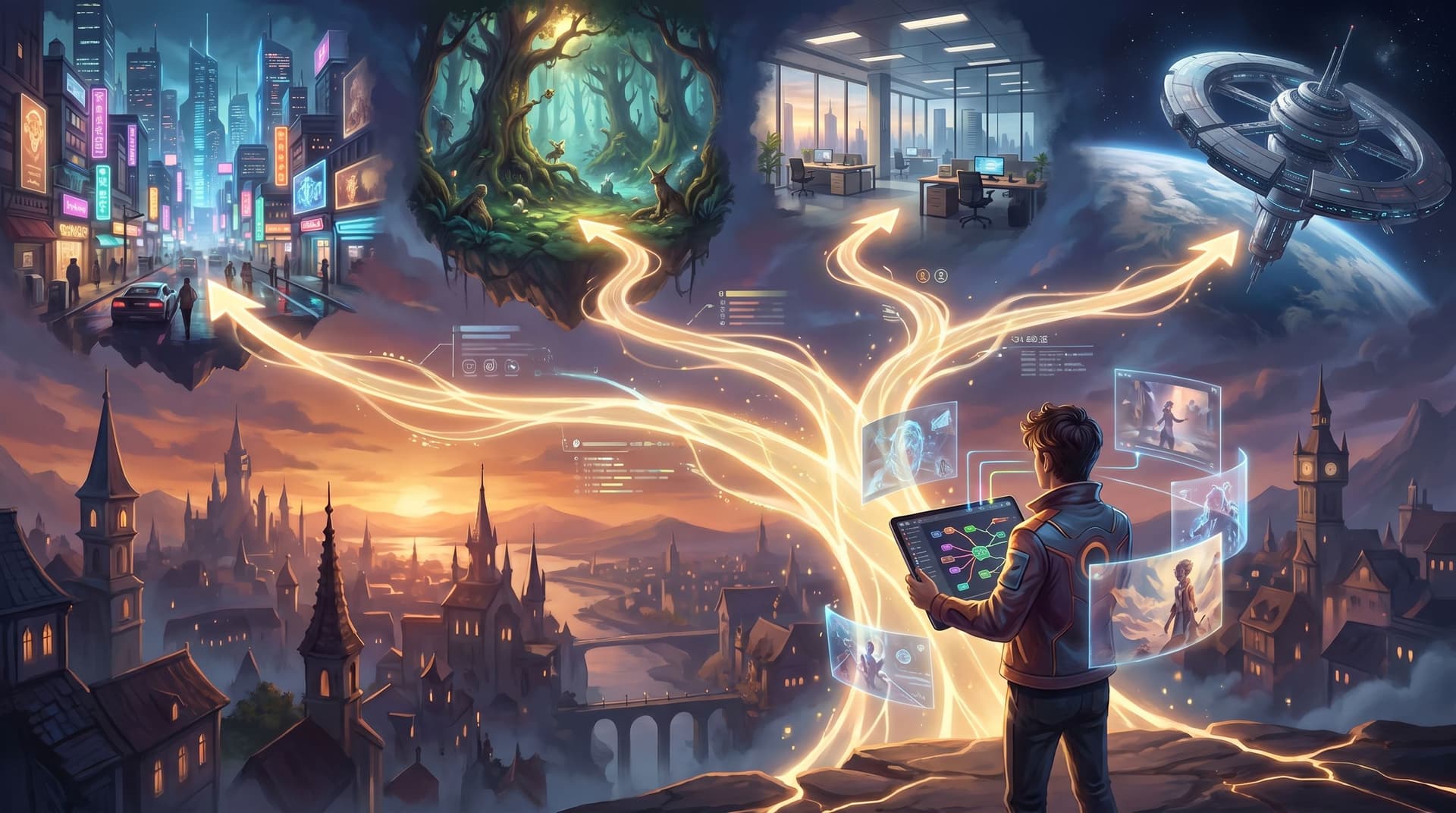
You’ve got a spark of a story world:
- A haunted orbital monastery where memories can be traded.
- A sales onboarding saga framed as a heist.
- A leadership program told through rival guilds in a fantasy city.
It’s vivid in your head—but is it worth months of writing, art direction, and iteration?
The smartest creators don’t guess. They prototype.
A playable pilot is a small, focused slice of your story world that real players can experience in an afternoon. Built in a visual, no‑code tool like Questas, it lets you test tone, mechanics, choices, and visual style before you invest in a full series.
This post walks through how to go from loose premise to a tight, testable pilot that answers the question: “Should I build this out, pivot, or shelve it?”
Why You Should Pilot Your Story World First
Whether you’re building for fun, training, marketing, or storytelling at work, committing to a big interactive project too early is risky.
Piloting first helps you:
- Avoid worldbuilding sinkholes. It’s easy to spend weeks on lore, timelines, and character bibles that never actually get used.
- Find the fun (or insight) faster. You see where players lean in, where they skim, and which choices feel meaningful.
- Align stakeholders early. A 10–20 minute playable prototype is far more persuasive than a 40‑page design doc or a sprawling flowchart. (If that flowchart pain is familiar, you’ll love how pilots tie into the ideas in From Flowchart Fatigue to Playable Prototypes.)
- Stress‑test your premise. Some ideas sound great in a pitch but fall flat when players actually make decisions inside them.
- Lock in a visual language. With AI‑generated images and video inside Questas, you can quickly try different styles and see what fits your world.
Think of a pilot as a story lab: a safe place to experiment, fail cheaply, and double down on what works.
Step 1: Sharpen Your Premise into a Playable Question
A premise like “space traders navigating political intrigue” is a good start—but pilots need a sharp, testable core.
Ask yourself:
- Who is the player being in this world?
- A rookie captain? A compliance officer? A new hire at a startup?
- What pressure are they under—right now?
- A shipment is missing.
- A client is about to churn.
- A safety incident just occurred.
- What’s the central dilemma of the pilot?
- “Do I protect my crew or my contract?”
- “Do I escalate this issue or handle it quietly?”
- “Do I follow the official process or improvise?”
Turn that into a single, crisp question your pilot will explore. For example:
“What does a new sales rep at Nova Systems do when their biggest prospect asks them to bend the rules?”
This question becomes your guiding star. Every scene, choice, and consequence in the pilot should help explore it.
Step 2: Define the Scope of a Pilot (So It Stays Small)
A good pilot in Questas is tight but replayable:
- Playtime: 10–20 minutes.
- Structure: 1–2 key decision clusters, a few smaller flavor choices, and 2–4 distinct endings.
- Content: Enough scenes to showcase your world’s tone, stakes, and core mechanics—no more.
To keep scope under control, constrain three things:
- Timeframe – Cover a single day, mission, or incident, not a whole career or campaign.
- Location – Focus on 2–3 locations you can visualize clearly (e.g., “briefing room, client office, rooftop extraction point”).
- Cast – 1 main character, 1–2 key supporting characters, and maybe 1 “voice of the world” (like a news feed, AI assistant, or narrator).
If you’re tempted to add more, ask: Does this help answer my core question? If not, it’s material for a future episode, not the pilot.
Step 3: Sketch a Minimal Story Spine
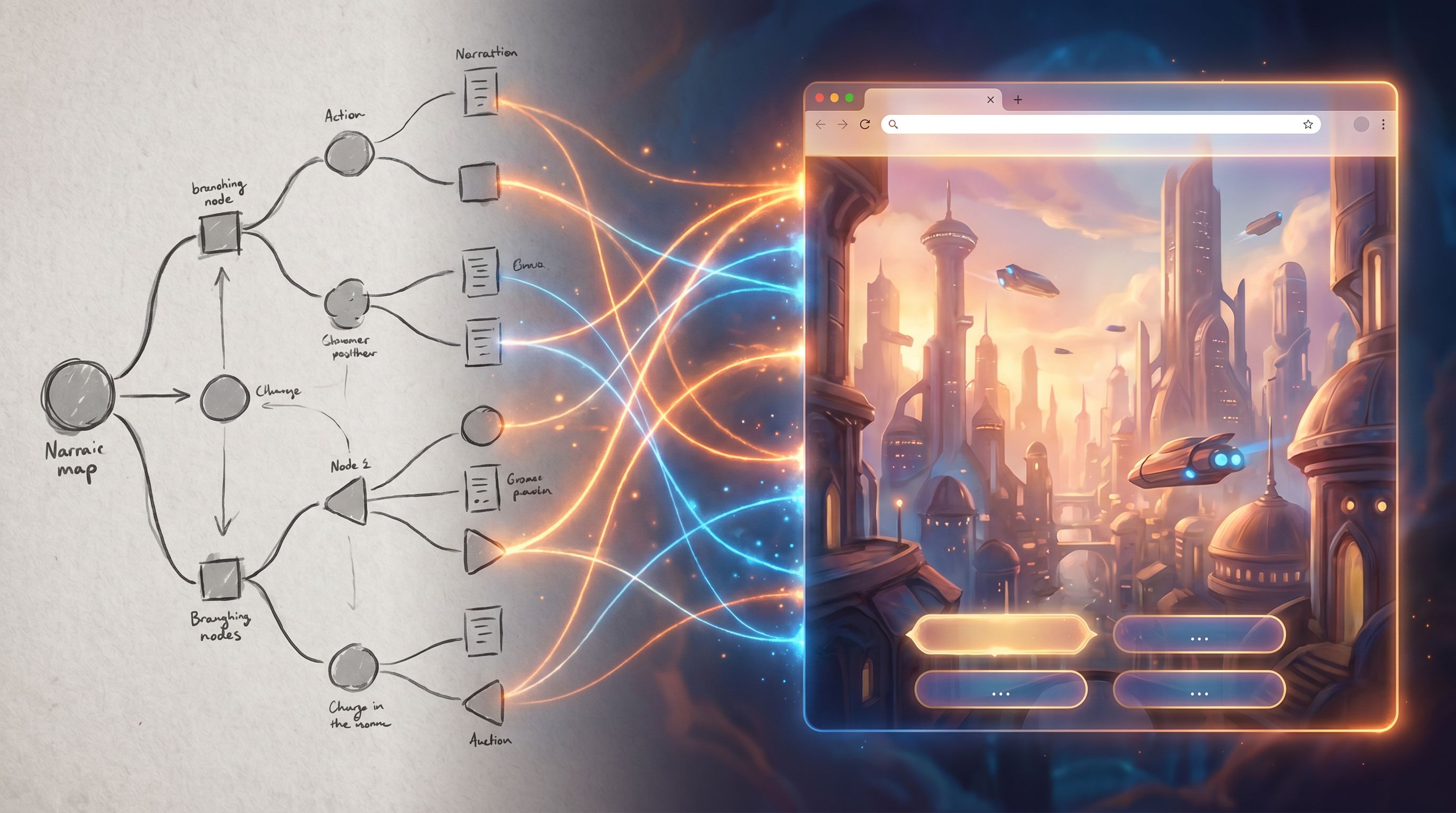
Before you touch the editor, sketch a story spine—a simple backbone you can hang branches on.
A reliable pattern for pilots:
- Hook scene – Drop the player into the situation quickly.
- Orientation scene – Let them understand context, stakes, and key relationships.
- Decision cluster #1 – A meaningful fork that reveals who they are in this world.
- Escalation scene – Consequences of that choice, raising tension.
- Decision cluster #2 – A higher‑stakes choice informed by what’s come before.
- Resolution scenes / endings – 2–4 payoffs that show the impact of their path.
You can think of this as a compact beat sheet; if you want to go deeper on pacing and beats later, check out From Branch Map to Beat Sheet: Structuring Scene Pacing in Complex Questas Stories.
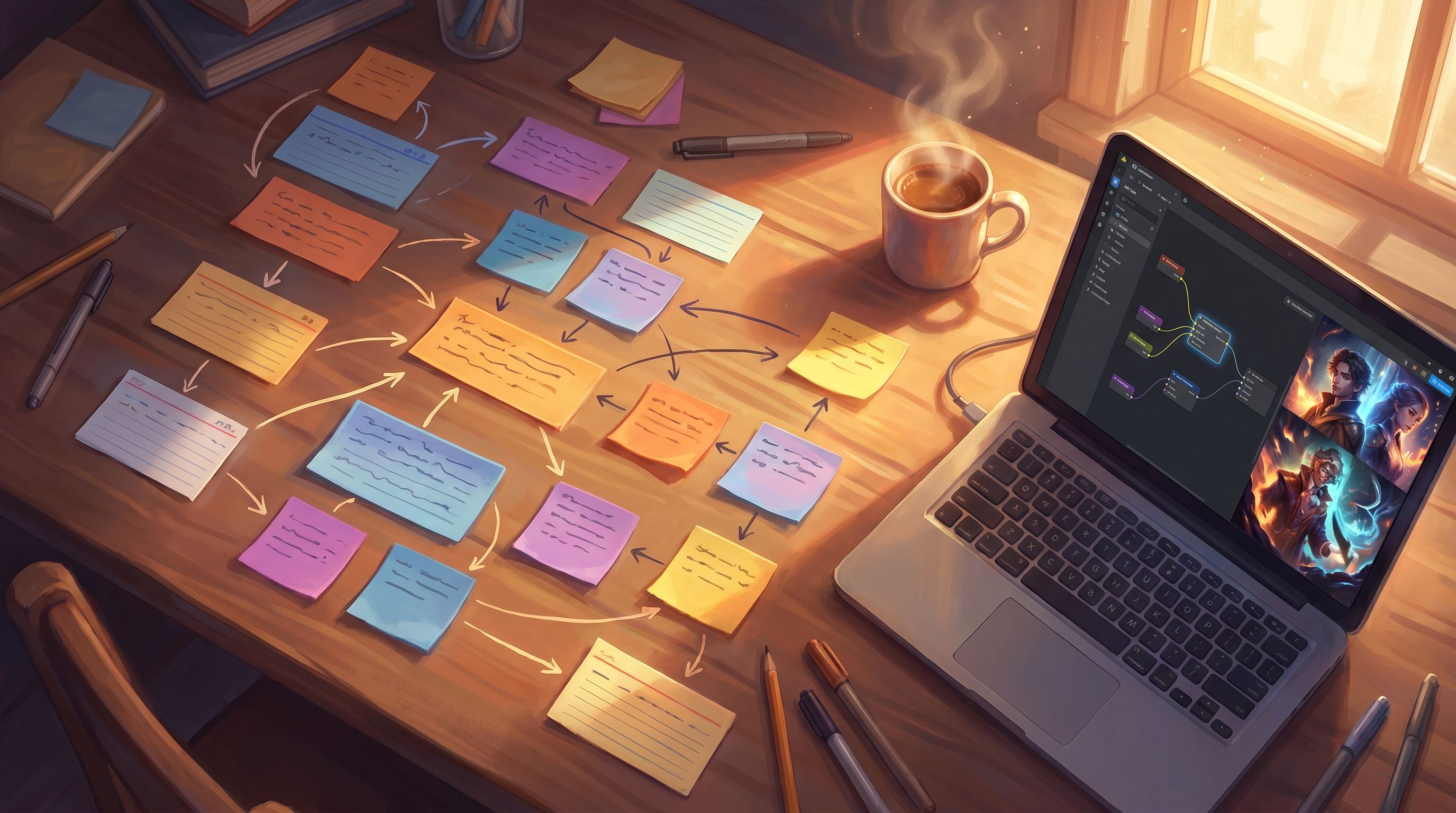
Keep this sketch lightweight: boxes, arrows, and short labels like “Client pushes for discount” or “Reveal: shipment is illegal.” You’re not scripting yet—you’re mapping emotional turns.
Step 4: Build a Bare-Bones Playable Loop in Questas
Now you’re ready to open the visual, no‑code editor and turn your spine into something playable.
Start with a linear path
Resist the urge to branch immediately. First, build a straight-through version of the story:
- Create scenes for each beat in your spine.
- Write simple, clear text for each scene—no need for literary polish yet.
- Add placeholder media prompts (e.g., “office boardroom at dusk, tense negotiation”).
Once players can move from start to at least one ending, you have a vertical slice: a complete, if simple, run.
Layer in your first decision cluster
Next, identify where your first meaningful choice belongs. In the editor:
- Split a scene into a choice node with 2–3 options.
- For each option, create a short branch of 1–2 scenes that show immediate consequences.
- Rejoin branches where it makes sense so your graph doesn’t explode.
A simple pattern:
- Choice A: “Play it safe” – leads to slower progress, but less risk.
- Choice B: “Take a risk” – leads to faster progress, but new complications.
This is also a great place to experiment with low‑stakes branches that build empathy and texture, as explored in The Quiet Choice: Using Low-Stakes Branches to Build Empathy, Not Just Drama, in Questas.
Add 2–4 endings
For your pilot, aim for endings that:
- Show different facets of your world. Maybe one ending reveals a hidden faction, another highlights systemic pressure.
- Teach you something about your premise. If all your “bad” endings feel more interesting than the “good” ones, that’s a design signal.
- Invite replay. Hint at what could have happened if the player had made different calls.
Don’t worry about perfect balance yet. You’re building a learning artifact, not a final release.
Step 5: Use AI Visuals to Explore Your World’s Look and Feel
One of the biggest advantages of building your pilot in Questas is how quickly you can explore visual directions.
Choose a visual north star
Decide on 1–2 adjectives each for:
- Mood: hopeful, gritty, whimsical, eerie, corporate, surreal…
- Style: painterly, comic‑book, cinematic, watercolor, low‑poly, retro pixel…
Then bake those into your prompts consistently:
“Gritty cyberpunk alley at night, neon reflections in puddles, cinematic lighting, 16:9.”
“Warm watercolor office interior, diverse team in casual clothes, cozy lighting, 4:3.”
Prototype characters and locations
For each key character and location in the pilot:
- Generate 1–3 images.
- Adjust prompts until they feel like they belong to the same universe.
- Note down prompt fragments that consistently work (your future visual bible).
If you plan to expand into a series later, the practices in AI as Art Director: Building Cohesive, On-Brand Visual Languages for Your Questas Series will help you turn these early experiments into a stable art direction.
Don’t over-polish
Remember: this is a pilot, not a final season. Good enough is:
- Characters are recognizable from scene to scene.
- Locations feel like variations of the same place, not random sets.
- The tone of the visuals matches the tone of your writing.
If you’re spending more time tweaking art than testing choices, you’ve drifted away from the purpose of the pilot.
Step 6: Design for Learning—About Your World and Your Audience
A pilot isn’t just for players; it’s a research tool for you.
What you want to learn
Before you share, write down 3–5 questions you want the pilot to answer, such as:
- Do players quickly grasp who they are and what they’re trying to do?
- Which choices feel meaningful vs. arbitrary?
- Is the tone (humorous, serious, dark, hopeful) landing as intended?
- Do people want another episode when they reach an ending?
Build in “listening posts”
Use Questas features and structure to capture signal:
- Branch analytics: Track which options players pick most and which endings they reach.
- Reflection scenes: After key decisions, add a short, optional text input: “Why did you choose that?”
- Post‑play questions: End with a quick poll or link to a survey asking what they’d like to see more or less of.
Embrace “bad” endings as research
Don’t shy away from failure states. As we explored in Designing Failure on Purpose: How to Use ‘Bad’ Endings to Teach, Not Punish, in Questas, well‑designed failures:
- Reveal how your world responds to mistakes.
- Surface ethical tensions or trade‑offs.
- Give you rich feedback on how players interpret your systems.
In a pilot, a sharp, memorable failure ending can be more valuable than a neat success.
Step 7: Run Small Playtests and Listen Hard
Now, share your pilot with a small, diverse group:
- 3–5 people who resemble your target audience.
- 1–2 people who don’t, just to see how accessible your world is.
Watch, don’t explain
If possible, observe someone playing (over screen share or in person):
- Where do they pause or reread?
- When do they smile, laugh, or frown?
- Do they ever say, “Wait, can I…?”—and if so, what are they trying to do that your story doesn’t allow yet?
Those “off‑script” impulses are gold, especially if you’re aiming for flexible, player‑driven experiences like the ones discussed in The Anti-Railroad Quest: Letting Players Go ‘Off Script’ Without Breaking Your Story.
Ask focused questions afterward
Instead of “Did you like it?”, try:
- “At what moment did you feel most ‘inside’ the world?”
- “Which choice felt like it really mattered?”
- “What did you expect to be able to do that you couldn’t?”
- “If this became a series, what would you want to explore next?”
Capture their words verbatim. They’ll often give you better copy and clearer stakes than your original pitch.
Step 8: Decide: Expand, Pivot, or Pause
A pilot’s job is not to prove your idea is perfect; it’s to give you enough information to choose your next move.
After a round of playtests, look at:
- Engagement: Do people finish a run? Do they immediately replay?
- Clarity: Do they understand who they are, what they’re doing, and why it matters?
- Emotional response: Are they curious, tense, amused, moved—or mostly confused and neutral?
- Feasibility: Could you realistically expand this into the series you imagine, given your time and resources?
Then make a call:
- Expand – If players are engaged, asking for more, and your premise still excites you, start outlining Season 1.
- Pivot – If some parts land and others don’t, keep the strongest elements (e.g., setting, character dynamic) and redesign around them.
- Pause – If the idea feels forced, it’s okay to shelve it. You’ve spent days—not months—learning that.
Whatever you choose, you now have:
- A working knowledge of Questas.
- A clearer sense of your voice in interactive form.
- Concrete assets and patterns you can reuse in future projects.
Quick Checklist: From Premise to Playable Pilot
Use this as a compact reference next time inspiration strikes:
- [ ] Write a one‑sentence, player‑focused premise.
- [ ] Frame a sharp, testable question for the pilot.
- [ ] Constrain scope: one incident, a few locations, a tiny cast.
- [ ] Sketch a 6‑beat story spine (hook → orientation → choice → escalation → choice → endings).
- [ ] Build a linear path in Questas.
- [ ] Add 1–2 decision clusters and 2–4 distinct endings.
- [ ] Prototype a consistent visual style with AI‑generated images.
- [ ] Define what you want to learn from the pilot.
- [ ] Run small playtests and collect both behavior data and qualitative feedback.
- [ ] Decide whether to expand, pivot, or pause.
Wrapping Up: Pilots as Your Creative Superpower
Committing to a big interactive story world is a leap. Building a playable pilot first turns that leap into a series of small, smart steps.
With a visual, no‑code platform like Questas, you can:
- Move from idea to testable experience in days.
- See how real people move through your world.
- Refine your premise, pacing, and visuals before you’re locked in.
You don’t need to wait until everything is perfect. You just need a premise, a question, and the willingness to let players in early.
Your Next Step
If a story world has been living rent‑free in your head, this is your nudge:
- Write your one‑sentence premise.
- Open Questas in a browser tab.
- Build a 10–20 minute pilot, not a magnum opus.
Let a handful of people play it. Listen to what the pilot teaches you. Then decide where your adventure goes next.
Adventure awaits—but you don’t have to commit to a whole season to take the first step.