From Safety Drills to Story Thrills: Building High-Stakes Training Scenarios in Questas

Safety training is supposed to prepare people for the worst days on the job—fires, data breaches, medical emergencies, angry customers, equipment failures. But too often, those trainings feel like box‑checking exercises: slide decks, multiple‑choice quizzes, and once‑a‑year drills everyone forgets a week later.
High-stakes scenarios demand more.
Interactive, branching stories let people live through critical moments before they happen. They can practice decisions, feel the pressure, and see consequences play out—without putting anyone in harm’s way. That’s where Questas, a web-based platform for building choose‑your‑own‑adventure experiences with AI‑generated visuals, becomes especially powerful.
This guide walks through how to turn traditional safety drills into story‑driven simulations that people actually remember—and want to replay.
Why High-Stakes Training Belongs in Interactive Stories
When the stakes are high, people don’t rise to the occasion—they fall to the level of their training. The problem is that many teams are still trained with:
- Static content (PDFs, manuals, slide decks)
- Low-pressure quizzes that reward memorization, not judgment
- Rare, resource-heavy drills that are hard to run often
Branching simulations built in Questas solve several of these pain points at once:
-
Psychological safety for real mistakes
Learners can make risky choices, miss cues, or escalate a situation—and see what happens—without real-world consequences. -
Decision-making over recall
Instead of “What is the correct procedure code?” you ask, “Your colleague is unresponsive near a live panel. What do you do first?” Choices matter more than trivia. -
Repeatable, consistent experiences
You can run the same scenario for hundreds of people without extra staff time, and still capture their different paths and outcomes. -
Rich context through visuals and micro‑video
AI-generated images and short loops make hazards, emotional cues, and environmental details visible. If you want to go deeper on this, check out how micro-cutscenes can signal danger and consequences in our post on storytelling with AI video loops.
Most importantly, interactive safety stories stick. When someone has played through a fire evacuation gone wrong, or a phishing attempt that spirals into a breach, they’re far more likely to recognize similar patterns in real life.
Choosing the Right High-Stakes Moments to Simulate
Not every policy needs a full branching scenario. Focus your Questas energy where it will matter most.
Look for moments that are:
- Time-sensitive – seconds or minutes matter (e.g., CPR, industrial shutdown procedures, active violence protocols).
- Ambiguous – reasonable people could disagree on the “right” move (e.g., when to escalate a customer complaint, whether to override a system alert).
- High-impact, low-frequency – rare, but catastrophic if handled poorly (e.g., chemical spills, data exfiltration, major outages).
- Emotionally charged – fear, anger, embarrassment, or confusion are part of the scenario (e.g., harassment reports, difficult family conversations in healthcare).
A simple way to prioritize:
- List your top 10 worst-case scenarios by impact.
- Score each 1–5 on: frequency, complexity, emotional intensity.
- Start with the scenarios that are high impact + high complexity, even if they’re rare.
Those are the ones where a safe, story‑driven rehearsal can do the most good.
Framing Your Scenario Like a Thriller (Without Being Sensational)
High-stakes training doesn’t have to be dry—but it also shouldn’t turn real risks into entertainment. The sweet spot is narrative tension with respectful realism.
When you begin a new project in Questas, ask:
-
Who is the protagonist?
A frontline worker? A shift lead? A security analyst? A nurse? Make the role clear so the player can step into their shoes. -
What’s the inciting incident?
The alarm goes off. A patient collapses. An email from the “CFO” requests urgent wire transfer. Start as close to the crisis as possible. -
What’s at stake?
Spell out the human, operational, and reputational costs. Not as scare tactics, but as context: “If the server room overheats, customer data could be lost permanently.” -
What constraints exist?
Limited time, incomplete information, conflicting instructions—these are realistic pressures that shape decisions.
Then, structure your scenario around a clear arc. For a deeper dive on structuring non‑linear narratives with a three‑act spine, our post on narrative arcs in nonlinear stories is a great companion.
Designing Branches That Teach, Not Just Punish
A common mistake in safety simulations is turning every “wrong” choice into a dead end. That might feel realistic, but it’s not great for learning.
In Questas, you can use branches to create learning-rich near misses, not just instant fail states.
Think in decision chains, not single forks
Instead of:
- “Do you pull the fire alarm? Yes → success. No → game over.”
Try:
- “You hesitate. Smoke thickens. What do you do now?”
- “You pull the alarm, but you forgot to close the fire door. How does that change evacuation?”
Each branch becomes a sequence of decisions, giving learners multiple opportunities to correct course—and see how early mistakes complicate later choices.
Turn consequences into teachable moments
When a player makes a risky choice:
- Show, don’t just tell, the outcome. Use AI images or a short loop to depict the result: spreading smoke, a server rack glowing red, a patient monitor flatlining.
- Provide a brief debrief in-character: a supervisor, incident report, or system log that explains what went wrong and why.
- Offer a rewind or alternate path so they can immediately try a different approach while the lesson is fresh.
If you want to push visual storytelling even further, see how to pace reveals and payoffs with imagery in Show, Don’t Tell: Using AI Images and Short Video Loops to Pace Your Questas Story Beats.
Building Your First High-Stakes Scenario in Questas: A Practical Workflow
Let’s walk through a concrete, repeatable process you can use for any safety or crisis simulation.
1. Start with a one‑page scenario brief
Before opening Questas, capture:
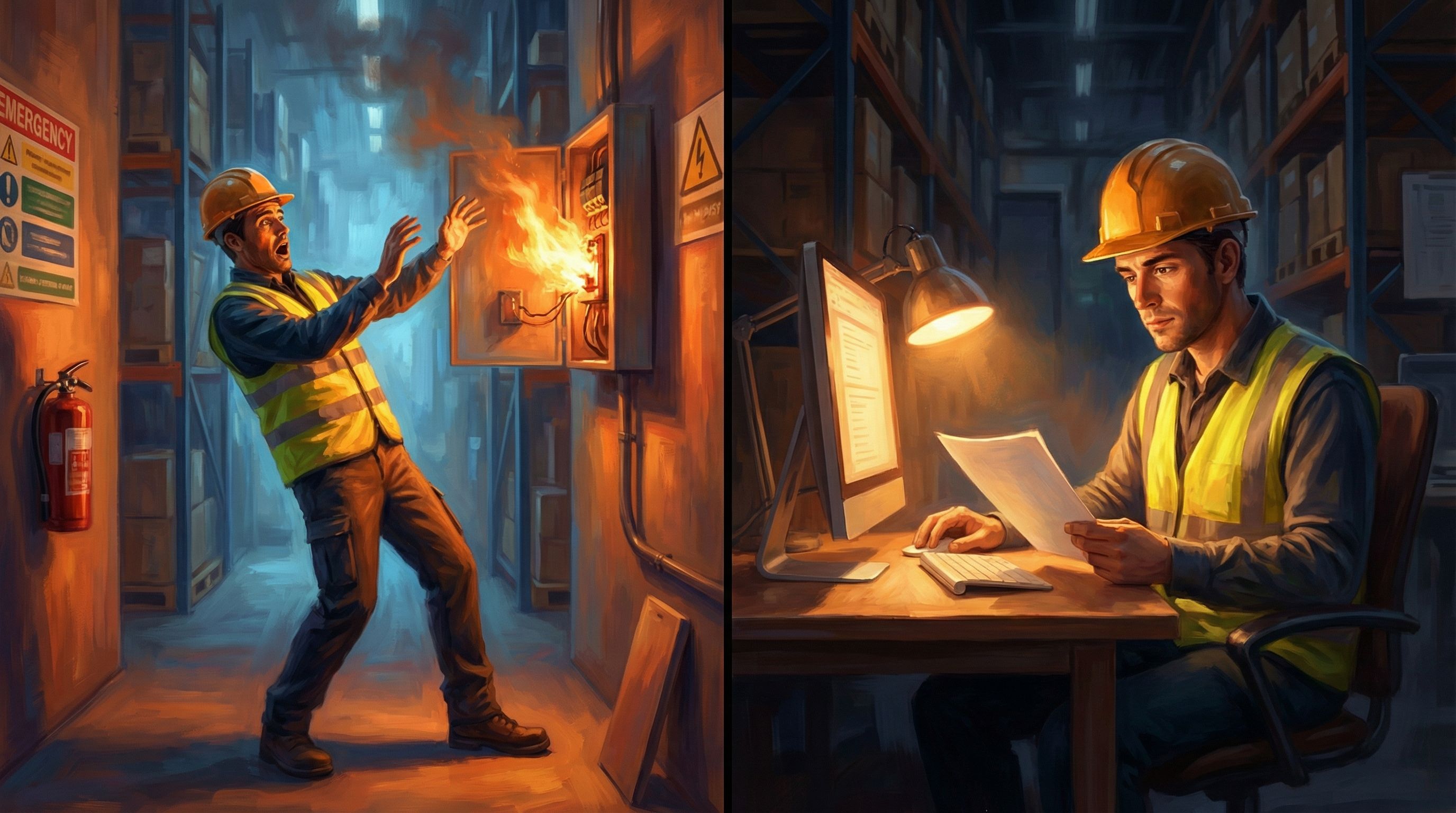
- Scenario title – “Night Shift Fire in Warehouse B”
- Audience/role – “New warehouse associates on night shift”
- Learning goals (3–5 max) – e.g.,
- Recognize early signs of electrical fire
- Execute correct alarm and evacuation sequence
- Prioritize personal safety over property
- Key decision points (5–10) – bullets only, no prose yet
- Must‑hit outcomes – what every player should see or learn, even across different branches
This keeps your build focused and prevents “branch explosion” later.
2. Map the critical path, then layer branches
Inside the visual, no‑code editor in Questas:
- Build the “ideal” path first – the sequence of best‑practice decisions from start to finish.
- Add 1–2 meaningful branches per decision – focus on the most likely or most instructive mistakes.
- Avoid early dead ends – instead, let poor choices make later scenes harder, tenser, or more constrained.
A simple structure that works well for safety scenarios:
- Scene 1–2: Onset – something’s wrong; gather information.
- Scene 3–5: Escalation – choose between competing priorities; stakes rise.
- Scene 6–8: Resolution – containment or failure, plus debrief.
3. Script dialogue and narration with pressure in mind
You don’t need pages of prose. You do need:
- Short, clear descriptions of what the player sees, hears, and feels.
- Concrete cues – flashing lights, acrid smell, a panicked coworker.
- Time pressure implied in the text – “You have seconds to decide.”
Keep choices:
- Mutually exclusive – no obvious “all of the above.”
- Plausible – avoid cartoonishly bad options; real mistakes are subtle.
- Aligned with real-world procedures – your story should reinforce, not contradict, official protocols.
4. Add AI-generated visuals that clarify, not clutter
With Questas, you can generate images and short video loops directly inside your scenes. For high-stakes training, visuals should:
- Highlight hazards and cues (sparks near a wet floor, a suspicious email UI, a patient’s skin tone).
- Reinforce emotional context (fear, urgency, confusion) without sensationalism.
- Stay on‑model and on‑brand—especially for uniforms, equipment, and environments.
If you’re new to visual consistency, our guide on AI Visual Styles 101 can help you match imagery to tone and audience.
Making Stakes Feel Real: Using Feedback, Metrics, and Micro-Cutscenes
Once your basic scenario is playable, you can dial up the sense of consequence without turning it into a horror show.
Use subtle micro-cutscenes at turning points
Short AI-generated video loops are ideal for:
- A flicker of flames jumping to nearby pallets
- A phishing email link being clicked and a loading spinner appearing
- A patient’s breathing becoming shallow
These 2–5 second loops create visual punctuation after big decisions. For more on using them to signal stakes and outcomes, revisit Storytelling with AI Video Loops: How to Use Micro-Cutscenes to Signal Stakes and Consequences in Questas.
Give players meaningful feedback, not just scores
At the end of a run, consider including:
- A narrative epilogue – what happened in the next hour/day/week because of their choices.
- A “command center” summary – incident timeline, key decisions, and their impact.
- Targeted coaching tips – 2–3 specific suggestions (“Next time, try isolating the circuit before re-entering the room.”).
You can also show:
- Branch comparisons – “In another path, you evacuated earlier and reduced injuries by 60%.”
- Replay prompts – “Want to try prioritizing equipment shutdown instead of manual fire suppression?”
This turns your scenario into a practice ground, not a one‑off exam.
Keeping It Ethical, Accurate, and Inclusive
High-stakes scenarios often intersect with sensitive topics: injury, illness, violence, harassment, or bias. When you’re using AI imagery and branching choices, you carry extra responsibility.
A few guardrails when building in Questas:
- Consult subject-matter experts – safety officers, clinicians, legal, HR. Make sure procedures and language match reality.
- Avoid graphic depictions – you can convey seriousness without gore or trauma porn. Focus on decisions and consequences, not shock value.
- Represent people thoughtfully – diverse characters in realistic roles; avoid stereotypes in who causes problems or who needs saving.
- Offer content warnings and support – especially for scenarios involving violence or medical emergencies.
For a deeper framework on responsible imagery and choice design, see our post on Ethical AI Worldbuilding: Guidelines for Responsible Imagery, Representation, and Choices in Questas.

Testing and Iterating Like a Safety Team (Not Just a Writer)
Your first version won’t be perfect—and that’s a feature, not a bug.
Treat each Questas scenario like a living safety asset:
- Run small pilots with 5–10 people from your target audience.
- Ask them to think aloud while they play: what’s confusing, what feels unrealistic, where choices feel missing.
- Afterward, gather feedback on:
- Clarity of instructions
- Realism of stakes and constraints
- Emotional impact (too mild, too intense, about right)
- Watch analytics (if you’re tracking them):
- Which branches are rarely seen?
- Where do people drop out?
- Are most players “failing” in the same spot?
- Revise scenes, choices, and visuals accordingly.
If you want a more formal playtesting process, our guide on Playtesting Your Questas Like a Game Designer offers scripts, checklists, and patterns to watch for.
Putting It All Together: What “Great” Looks Like
A strong high-stakes training scenario built in Questas usually has:
- A clear, relatable role for the player to inhabit
- A tight inciting incident that drops them directly into the moment that matters
- 5–10 meaningful decision points that mirror real-world judgment calls
- Branches that explore realistic mistakes and near misses, not just binary success/failure
- AI-generated visuals and micro‑video that highlight cues, hazards, and emotional beats
- Thoughtful debriefs and coaching that turn outcomes into learning
- Ethical, accurate, inclusive design reviewed by experts
- Ongoing iteration based on player behavior and feedback
When you hit that bar, you’re no longer running “training.” You’re running simulations that people talk about afterward—“Remember that warehouse fire scenario? I’ll never forget how quickly the smoke spread when I hesitated.”
Quick Recap
- High-stakes training—safety, security, crisis response—benefits enormously from interactive, branching simulations.
- Questas lets you build those simulations without code, combining structured choices with AI-generated images and video.
- Start by prioritizing the right scenarios, then frame them with a clear protagonist, inciting incident, and stakes.
- Design branches as decision chains with teachable consequences, not just gotcha failures.
- Use visuals and micro‑cutscenes to show outcomes and cues, while staying ethical and realistic.
- Playtest, measure, and iterate so your scenarios grow with your team’s needs.
Ready to Turn Drills into Thrilling Simulations?
If your current safety or crisis training lives in slides, PDFs, or once‑a‑year drills, this is your moment to try something different.
Pick one high-impact scenario—a fire alarm, a data breach, a medical emergency on the shop floor—and:
- Write a one‑page brief.
- Open Questas.
- Build the critical path, then layer in 1–2 key branches.
- Add just enough visuals to make the stakes feel real.
- Share it with a small pilot group and watch how they respond.
You don’t need to rebuild your entire training library overnight. You just need one powerful, memorable scenario that proves the value of interactive practice.
From there, you can expand into a full catalog of high-stakes adventures—giving your people a safe place to make mistakes before the real alarm goes off.
Adventure awaits. And this time, it might just save someone’s day.