Interactive Thought Experiments: Turning ‘What If?’ Questions into Playable Questas Scenarios

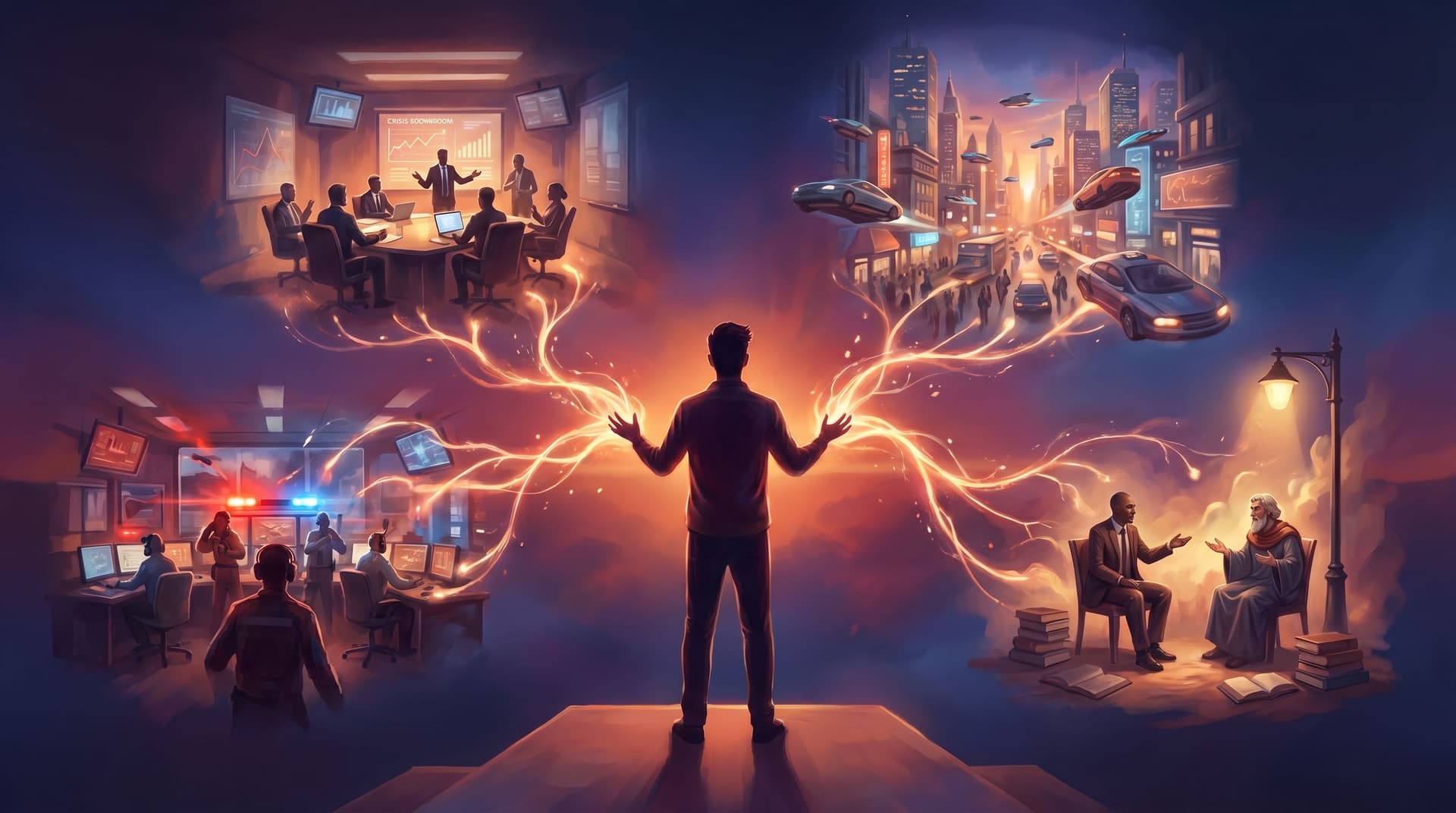
Thought experiments are how humans rehearse reality.
What if I quit my job?
What if the AI really is conscious?
What if the reactor fails and the backup doesn’t kick in?
Philosophers, scientists, leaders, and storytellers have used these “what if?” questions for centuries to test ideas, expose hidden assumptions, and explore consequences without real‑world risk.
Now you don’t have to leave them on the whiteboard or in a late‑night conversation. With interactive, branching stories, you can turn thought experiments into playable experiences—letting people step inside a question and explore its branches.
That’s where platforms like Questas shine: you can take a single “what if?” and build it into a no‑code, visual scenario with AI‑generated images and videos, then share it as a link, embed, or live experience.
This post is a practical guide to turning your favorite thought experiments into interactive Questas scenarios people can actually play.
Why Thought Experiments Belong in Interactive Form
Thought experiments already behave like branching stories in your head:
- You imagine a situation.
- You try one decision.
- You rewind mentally and try another.
- You compare outcomes.
Making them interactive inside Questas takes that private mental simulation and turns it into a shared, structured space where others can:
-
Test complex decisions safely
From ethics training to policy rollouts, people can explore consequences without risk to real customers, employees, or systems. -
Reveal hidden assumptions
When players choose different branches, you see where their mental models diverge—gold for trainers, researchers, and facilitators. -
Drive deeper engagement
Interactive scenarios consistently outperform static content on completion and recall. People remember what they did, not what they skimmed. -
Create reusable “thinking tools”
A good thought‑experiment scenario can be replayed by new cohorts, adapted to new contexts, or extended into a series.
If you’re already building training, workshops, or stories, you’re likely sitting on a list of “what if?” questions. Turning them into playable scenarios is one of the fastest ways to create high‑impact content.
From Vague Question to Playable Scenario: A Simple Workflow
Let’s walk through a concrete workflow you can use for almost any thought experiment.
1. Choose the Right Kind of “What If?”
Not every question wants to be a scenario. The best candidates share three traits:
-
There’s a decision.
Good: What if our hiring panel ignores salary history?
Vague: What if humans are inherently creative? -
There are stakes.
Good: What if the clinical trial data is ambiguous but the disease is spreading?
Low‑stakes: What if we rename our Slack channels? -
There’s genuine uncertainty.
Good: What if we delegate final say on product roadmap to a rotating council?
Trivial: What if we paint the office blue instead of green?
If you’re stuck, try reframing your topic like this:
“Imagine a person in situation X. They must decide between A, B, and C. What happens next?”
That sentence is almost your opening node in Questas.
2. Define the Core Dilemma, Not the Whole Plot
Thought experiments work because of a sharp dilemma, not because of elaborate lore.
Before you open the editor, answer three questions in a sentence each:
-
Who is making the decision? (role, not backstory)
“A mid‑level product manager at a fintech startup.” -
What are they deciding between? (2–4 options)
“Ship a risky feature on schedule, delay for more testing, or ship to a subset of users.” -
Why does it matter? (clear stakes)
“A failure could trigger regulatory scrutiny; a delay could cost the company a major partnership.”
These answers become:
- The opening scene text
- Your first choice node
- The stakes copy you echo in later branches
For more on anchoring scenarios in real‑world decisions, you might like Scenario‑First Story Design: Building Training Questas That Start with Real‑World Decisions.
3. Sketch the Branching Structure on One Page
Before you touch AI or visuals, sketch a lightweight map. A simple pattern works well for thought experiments:
- Node 1: Setup + core dilemma (2–4 choices)
- Nodes 2–4: Immediate consequences of each choice
- Nodes 5–8: Second‑order consequences (how others react, delayed effects)
- Nodes 9–12: Reflective outcomes (what was gained, what was lost, what changed long‑term)
Aim for breadth over depth at first:
- 3–4 branches that go 2–3 levels deep are often more insightful than 1 branch that goes 8 levels deep.
- You can always add nuance later using hidden meters and callbacks (see below).
If you’re used to linear writing, this is where The One‑Evening Story Sprint: Shipping a Complete Questas Prototype from Blank Page to Playtest can help you keep scope sane.
4. Turn Assumptions into Systems (Without Code)
Thought experiments are really about assumptions:
- “If we do X, people will probably feel Y.”
- “If we prioritize A, we’ll inevitably sacrifice B.”
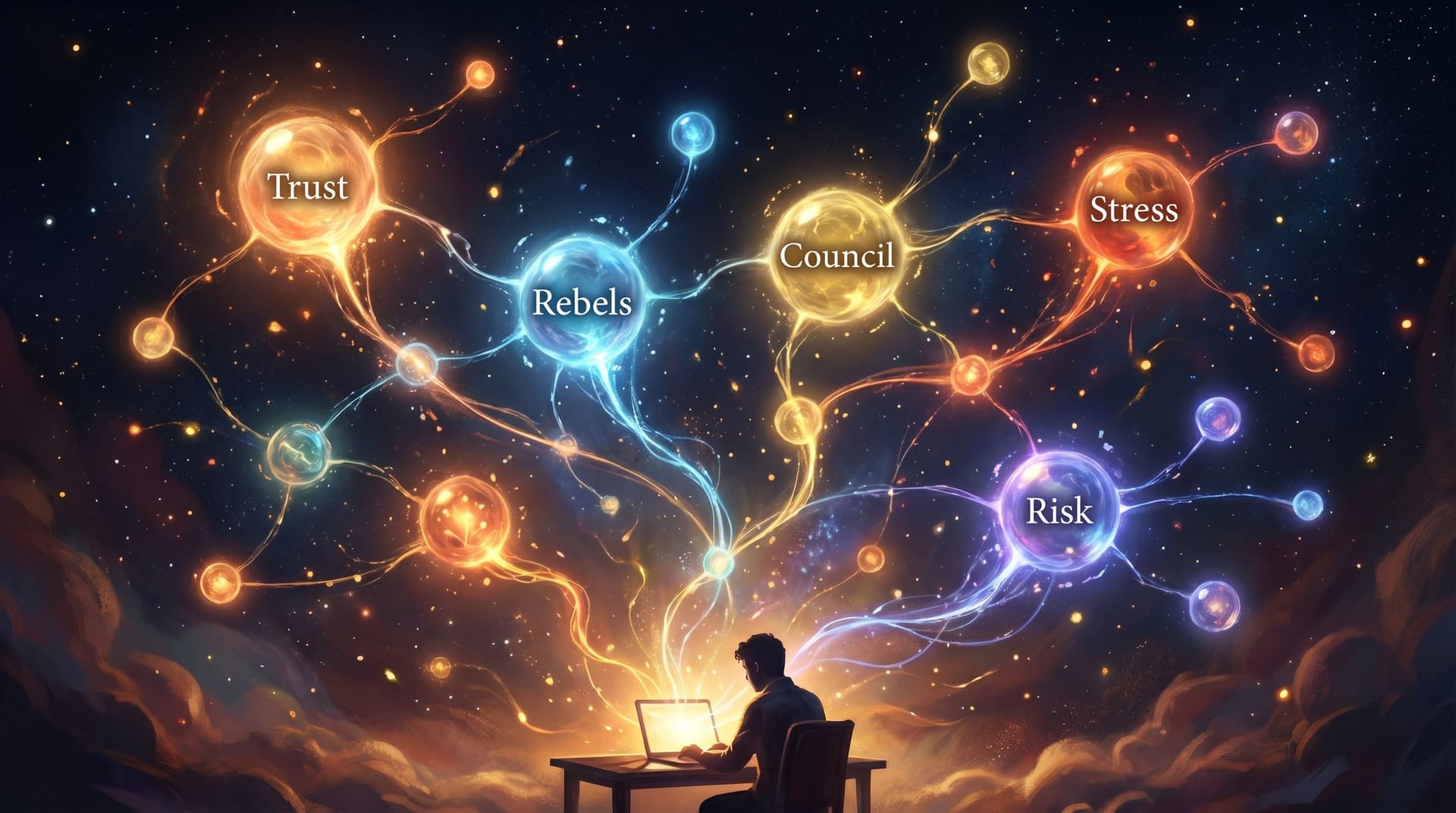
In Questas, you can represent those assumptions as meters and tags instead of just prose. For example:
- Trust Meter – goes up when the protagonist is transparent; down when they hide information.
- Risk Appetite – tracks how often the player chooses bold vs. conservative options.
- Equity Index – measures how decisions affect different groups.
Then you:
- Increment/decrement these meters silently in the background.
- Use them to gate later branches or change tone and outcomes.
This is exactly the kind of system design covered in depth in No‑Code, All Systems: Building Reputation, Factions, and Hidden Meters in Questas Without a Dev Team. For thought experiments, even one or two meters can dramatically increase the sense of consequence.
Designing Thought Experiments for Different Domains
Let’s look at how the same principles apply across a few common use cases.
1. Ethics and Philosophy
Classic thought experiments—like the trolley problem—are perfect for interactive treatment.
Example scenario ideas:
- The Autonomous Ambulance: An AI ambulance must choose between routes with different risk profiles for patient and pedestrians.
- The Data Donation Dilemma: A researcher must decide how much anonymized user data to share to accelerate medical breakthroughs.
Design tips:
- Avoid cartoonishly obvious “good vs evil” options; instead, trade values against each other (safety vs autonomy, privacy vs public good).
- Use reflective outcomes where the character debriefs with a mentor, critic, or journalist who challenges their reasoning.
- Let players replay quickly from the first choice so they can compare branches side‑by‑side.
2. Policy and Organizational Change
Policy rollouts are full of what‑ifs:
- What if a new hybrid‑work policy is interpreted differently by managers?
- What if a data‑retention rule conflicts with a team’s favorite tooling?
Here, thought‑experiment scenarios become change journeys. You can:
- Let players inhabit different roles (employee, manager, HR partner).
- Surface unintended consequences of well‑meant policies.
- Test messaging and edge cases before a real rollout.
For a deeper dive into this style of scenario, check out Beyond PDFs and Portals: How HR Teams Can Turn Policy Rollouts into Playable Questas Change Journeys.
3. Safety, Risk, and Incident Response
Health, safety, and incident‑response teams already use tabletop exercises—basically live thought experiments. Turning them into Questas scenarios lets you:
- Standardize the scenario.
- Let people practice asynchronously.
- Capture data on which paths people actually choose.
Example prompts:
- What if the facility loses power during a storm and backup systems partially fail?
- What if a critical vendor is compromised and you discover it mid‑launch?
Blend procedural correctness (follow the right steps) with moral and political nuance (who gets informed when, what gets documented, who takes responsibility). The post Branching Narratives for Health and Safety: Turning Procedures and Protocols into Rehearsable Questas Scenarios goes deep on this pattern.
4. Creativity, Fiction, and Worldbuilding
Thought experiments aren’t just for serious topics. They’re also the engine of speculative fiction:
- What if magic was regulated like nuclear energy?
- What if cities were sentient and could vote?
- What if your memories were a subscription service?
In Questas, you can:
- Use AI images and video to visualize alternate histories or futures.
- Let players explore multiple competing theories of how your world works.
- Turn fan debates into canon‑shaping choices across a series.
If you’re extending an existing IP or fandom, From Static IP to Living Canon: Keeping Fan Theories and Player Choices in Sync Across a Questas Series is a useful companion read.
Using AI Visuals to Make the Abstract Feel Concrete
Thought experiments can feel heady or abstract. Visuals help anchor them in specific moments:
- A tense boardroom during a pivotal vote.
- A crowded metro station as an emergency unfolds.
- A quiet office late at night before a whistleblower hits “send.”
With AI generation inside Questas, you can:
- Rapidly explore alternative visual framings of the same scenario (e.g., zoomed‑out cityscape vs. close‑up on a character’s face).
- Create consistent visual motifs for different values or outcomes (e.g., warm light for transparency, cool shadows for secrecy).
- Prototype scenes in minutes, then refine once you know which branches matter most.
For more structured guidance on this, see AI as Location Scout: Rapidly Prototyping Believable Worlds and Setpieces for Your Questas and Writing with the Camera in Mind: Cinematic Techniques for Framing AI Images in Your Questas Scenes.
A few practical tips specific to thought experiments:
-
Focus on human expression.
Close‑ups on faces often convey the weight of a dilemma better than wide technical shots. -
Use environment to hint at stakes.
Emergency lights, news tickers, protest signs, or dashboards can all subtly signal context without exposition. -
Avoid visual overload.
Let the decision text carry the nuance; use images to set mood and anchor place, not to cram in every detail.
Making Your Thought Experiments Replayable and Social
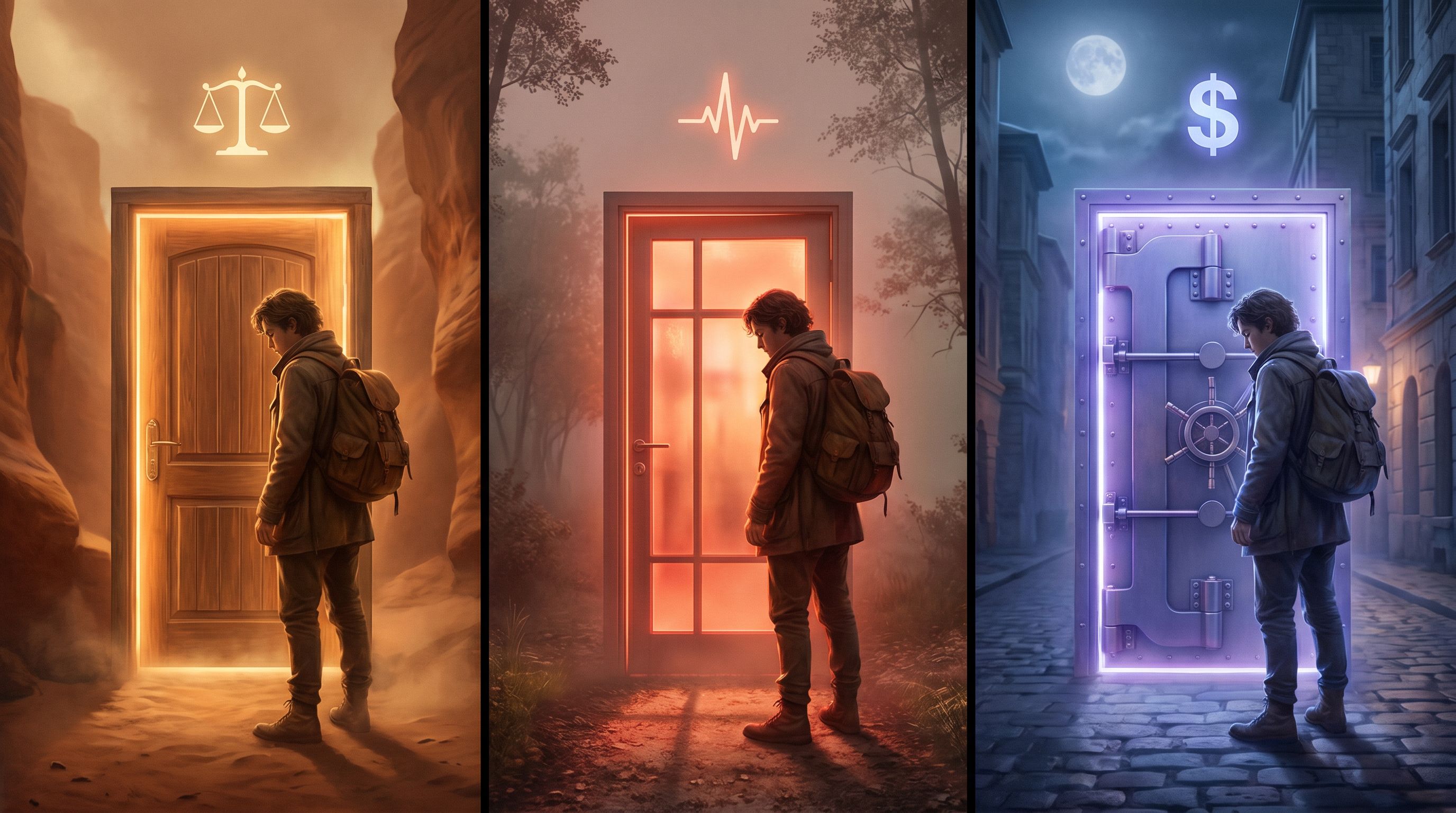
The magic of interactive thought experiments isn’t just the first playthrough—it’s replaying and comparing.
You can design for that explicitly:
-
Short loops, strong contrasts
Keep a single run under 10 minutes so people feel free to replay. Make sure different choices lead to meaningfully different experiences, not just different flavor text. -
Endcards that summarize the path
Show:- Key decisions taken
- How meters (trust, risk, equity) ended up
- A short reflection prompt players can discuss with others
-
Facilitated runs
Run your Questas scenario live with a group: project it, let the room vote on choices, then debrief. The post The Multiplayer Question: Turning Single-Player Questas Stories into Shared, Facilitated, and Asynchronous Experiences has concrete formats for this. -
Asynchronous cohorts
Share the same scenario with a class, team, or community and have them:- Screenshot their endcards.
- Compare choices in a forum or meeting.
- Debate which path they’d consider “best” and why.
This is where thought experiments reclaim their original role: not to prove a single “correct” answer, but to surface values, tradeoffs, and reasoning styles.
A Quick Checklist for Your First Interactive Thought Experiment
When you’re ready to build, use this as a sanity check inside Questas:
- One sharp dilemma at the start, no more than 2–4 options.
- Clear stakes stated in the opening scene.
- A simple branch map (breadth over depth for version one).
- At least one hidden meter tracking a value that matters (trust, risk, equity, etc.).
- Two or three key visuals that anchor mood and place.
- Distinct outcomes that feel:
- Plausible
- Different from each other
- Worth discussing
- An endcard summary that invites reflection and replay.
Ship that version, playtest with a handful of people, then iterate based on where they:
- Hesitate
- Feel surprised
- Complain that the scenario “isn’t fair” (often a sign your assumptions need tuning)
Bringing It All Together
Thought experiments have always been interactive—you just ran them in your head or in a seminar room. Turning them into playable Questas scenarios lets you:
- Capture those “what if?” conversations as reusable experiences.
- Let people practice reasoning under uncertainty instead of just hearing about it.
- Make abstract topics concrete, visual, and emotionally resonant.
- Collect data and reflections you can use to refine policies, training, or stories.
Whether you’re exploring ethics, stress‑testing a policy, rehearsing incident response, or building speculative fiction, the process is the same: start with a sharp dilemma, sketch a small branch map, encode your assumptions as simple systems, and let players explore.
Your Next Step
Don’t start with a magnum opus. Start with one question that’s been nagging at you or your team.
- Write it as a concrete dilemma for a specific character.
- Sketch 2–3 branches and their immediate consequences.
- Open Questas, build a tiny prototype with a couple of AI‑generated scenes, and share it with one colleague or friend.
By this time next week, you could have a fully playable thought experiment that people can explore, replay, and debate—turning your “what if?” into a shared, living scenario instead of a forgotten sticky note.
Adventure awaits. Your next thought experiment is ready to be played.