No-Code, All Systems: Building Reputation, Factions, and Hidden Meters in Questas Without a Dev Team

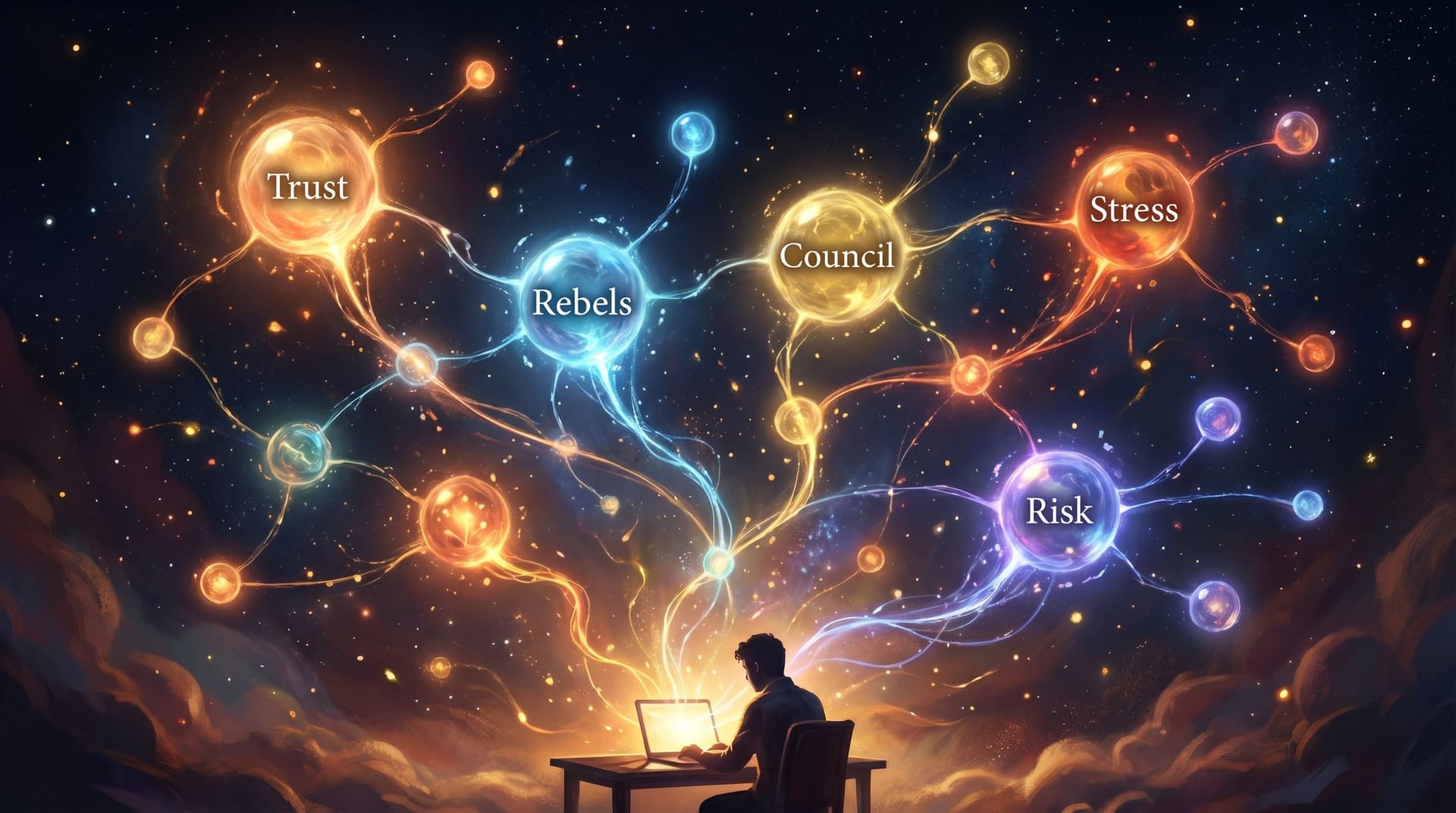
Interactive stories get truly memorable when choices echo.
Not just, “You picked the left door, so you see a different room,” but:
- A mentor remembers you lied three scenes ago.
- A rebel faction quietly tracks how often you help them.
- Your “stress” level spikes after a brutal decision, unlocking a breakdown later.
That’s systems design: invisible meters, reputations, and factions quietly shaping what’s possible. It’s what makes RPGs and narrative games feel alive—and for a long time, it was something you needed a dev team to pull off.
With Questas, you can build those systems visually, without writing a line of code.
This guide walks through how to design and implement reputation, factions, and hidden meters in your stories using Questas’ no‑code tools—plus practical patterns you can reuse across training, marketing, education, and entertainment.
Why Invisible Systems Make Your Stories Feel Alive
Before we dive into how, it’s worth getting clear on why to add this layer at all.
1. Choices start to feel meaningful
When players sense that the story is “keeping score” in subtle ways, they:
- Read more carefully.
- Anticipate consequences.
- Replay to see what else could have happened.
A simple example: a trust meter with a key NPC. Help them a few times, and they open up a risky shortcut later. Undermine them, and they withhold information at the worst possible moment.
2. You can simulate complex realities without walls of text
Hidden meters are perfect for:
- Training scenarios that track risk, compliance, or empathy.
- Change management stories that track buy‑in vs. resistance (see also how HR teams use interactive journeys in Beyond PDFs and Portals).
- Sales or negotiation roleplays that track rapport, urgency, or perceived value.
Instead of explaining, “This is risky,” you model risk as a meter that gates later options.
3. You unlock replayability and personalization
Once you have a few systems running under the hood, you can:
- Offer branches that only appear for certain play styles.
- Tailor feedback at the end based on how someone played.
- Let teams “rehearse” multiple strategies, not just one “correct” path (a pattern we also use in Scenario-First Story Design).
The best part: you don’t need spreadsheets and custom code. You can do it all in Questas’ visual editor using variables, conditions, and a bit of systems thinking.
Core Building Blocks in Questas: Variables, Conditions, and Tags
You can think of systems design in Questas as three main ingredients:
- Variables – your hidden meters (numbers or flags).
- Conditions – rules that check those meters to show/hide content.
- Tags / Labels – the story design layer that keeps everything understandable.
Let’s break them down.
Variables: Your Hidden Meters
Variables are where you store:
- Reputation scores (e.g.,
guild_rep,manager_trust) - Factions (e.g.,
faction_rebels,faction_corp) - States (e.g.,
is_injured,knows_secret,has_keycard) - Soft stats (e.g.,
stress,curiosity,risk_tolerance)
In Questas, you’ll typically:
- Create a variable in your story settings or directly on a node where it’s first used.
- Choose a type (number, boolean, text) depending on what you’re tracking.
- Initialize it (e.g.,
guild_rep = 0,is_injured = false).
Pro tip: Name variables semantically, not just rep1, rep2. Future‑you will thank you when your story hits 80+ nodes.
Conditions: When Systems Change the Story
Conditions are the “if this, then that” rules that:
- Change which choices appear.
- Route players to different nodes.
- Swap out text or media.
Examples:
- Only show the “Call in a favor from the Guild” option if
guild_rep >= 3. - Route to a “You’re too burned out to continue” scene if
stress >= 7. - Show a different version of a debrief if
empathy_score < 0.
In Questas, you’ll typically add conditions to:
- Choices (to hide/show them).
- Node transitions (to branch based on meters).
- Sometimes UI elements or text blocks (for subtle variations).
Tags and Labels: Keeping Systems Human-Readable
As your story grows, you’ll want a way to see at a glance:
- Which nodes raise or lower a given meter.
- Where gates or payoffs live.
Use labels like:
+Rebels,-Corp,Stress Spike,Trust Check,Hidden Gate.- Color‑coding (where supported) to group system‑heavy nodes.
This is especially helpful if you’re building complex adventures like the dungeons and heists described in AI as Dungeon Builder.

Designing a Reputation System Step by Step
Let’s walk through a concrete example: a reputation system with two rival factions.
Imagine a story where the player navigates a tense city: the Rebels vs. the Council.
Step 1: Decide What Reputation Means
Before touching the editor, answer:
- What does high Rebel rep unlock? (Smuggling routes, insider info?)
- What does high Council rep unlock? (Official support, legal cover?)
- What happens if you’re neutral or disliked by both?
Write down 3–5 concrete payoffs, such as:
- A unique late‑game mission for each faction.
- Different endings or epilogues.
- Special dialogue where NPCs react to your past.
Step 2: Create Your Variables
In Questas:
- Add
rep_rebels(number, starts at 0). - Add
rep_council(number, starts at 0).
You might also add a helper variable like rep_visibility if you ever plan to show meters to players in certain modes.
Step 3: Start Awarding and Deducting Points
On key choices:
- Helping Rebels?
rep_rebels += 1, mayberep_council -= 1. - Reporting Rebels to Council? Reverse the math.
- Staying neutral? No change—or small changes to both, depending on your design.
Not every choice needs to move a meter. In fact, sparing use of adjustments keeps them meaningful.
Step 4: Add Soft Gates Along the Way
Instead of saving all your payoffs for the finale, sprinkle in:
- Minor perks (a small shortcut if
rep_rebels >= 2). - Warnings (an NPC hints that “people are talking about you” if
rep_council <= -1). - Optional scenes that only appear for certain thresholds.
In Questas, that looks like:
- Adding a conditional branch from a node: if
rep_rebels >= 2, route to a special scene; else, route to the default. - Creating a choice that only appears when a condition is met (e.g., “Ask the Rebel quartermaster for help” visible only if
rep_rebels >= 3).
Step 5: Pay It Off in the Climax and Epilogue
Players should feel that their overall pattern mattered.
Examples:
- Final mission structure changes entirely depending on which faction you’ve favored.
- Debrief scenes summarize your relationships: “The Council sees you as a liability,” or “The Rebels whisper your name with respect.”
- In training or coaching stories, use these meters to generate tailored feedback: “You consistently prioritized short‑term wins over long‑term trust.”
Technically, it’s just variables and conditions. Narratively, it feels like a world reacting to them.
Factions as Lenses, Not Just Scoreboards
A faction isn’t only a number; it’s a perspective on the player’s behavior.
When you design factions in Questas, think in terms of:
- Values – What does this group care about above all?
- Red lines – What actions permanently damage your standing?
- Signature rewards – What can only they offer?
For example, in a workplace coaching scenario:
- “Factions” might be Leadership, Peers, and Direct Reports.
- Actions like “escalate immediately to your VP” could boost Leadership trust but lower Peer support.
- Later, only certain groups advocate for your promotion depending on these meters.
This approach pairs nicely with the ideas in Office Politics, But Make It Playable, where office dynamics become something you can safely practice.
Implementation pattern:
- One variable per group (e.g.,
rep_leadership,rep_peers,rep_reports). - Key decisions adjust 2–3 of these at once.
- Endings or feedback nodes read all three to generate nuanced outcomes.
Hidden Meters for Emotion, Risk, and Mastery
Not all meters need to be social. Some of the most powerful systems are internal.
Emotional States
Track things like:
stressconfidenceempathy
Then:
- Increase
stresswhen players choose rushed or confrontational options. - Decrease
stresswhen they take breaks, seek support, or regulate. - Gate certain choices behind high or low emotional states (e.g., you can’t access a calm negotiation option if
stress >= 6).
In therapy or coaching contexts (see Branching Narratives for Therapists and Coaches), these meters can:
- Surface patterns: “You often chose self‑sacrifice over boundary setting.”
- Power reflective debriefs that feel personalized.
Risk and Safety
For health, safety, or compliance training, hidden risk meters are gold.
risk_scoreclimbs when players cut corners.- Certain high‑risk combinations unlock incident scenes.
- Low
risk_scoreunlocks “nothing bad happened—but here’s why your decisions mattered” debriefs.
If you’re building scenarios like those in Branching Narratives for Health and Safety, this pattern lets learners feel consequences without real‑world danger.
Mastery and Difficulty
You can also use meters to adapt difficulty:
- Track
successesandfailures. - If someone is struggling, quietly route them through paths with more hints.
- If they’re cruising, unlock optional hard‑mode branches.
This complements the techniques in Adaptive Difficulty in Interactive Stories.
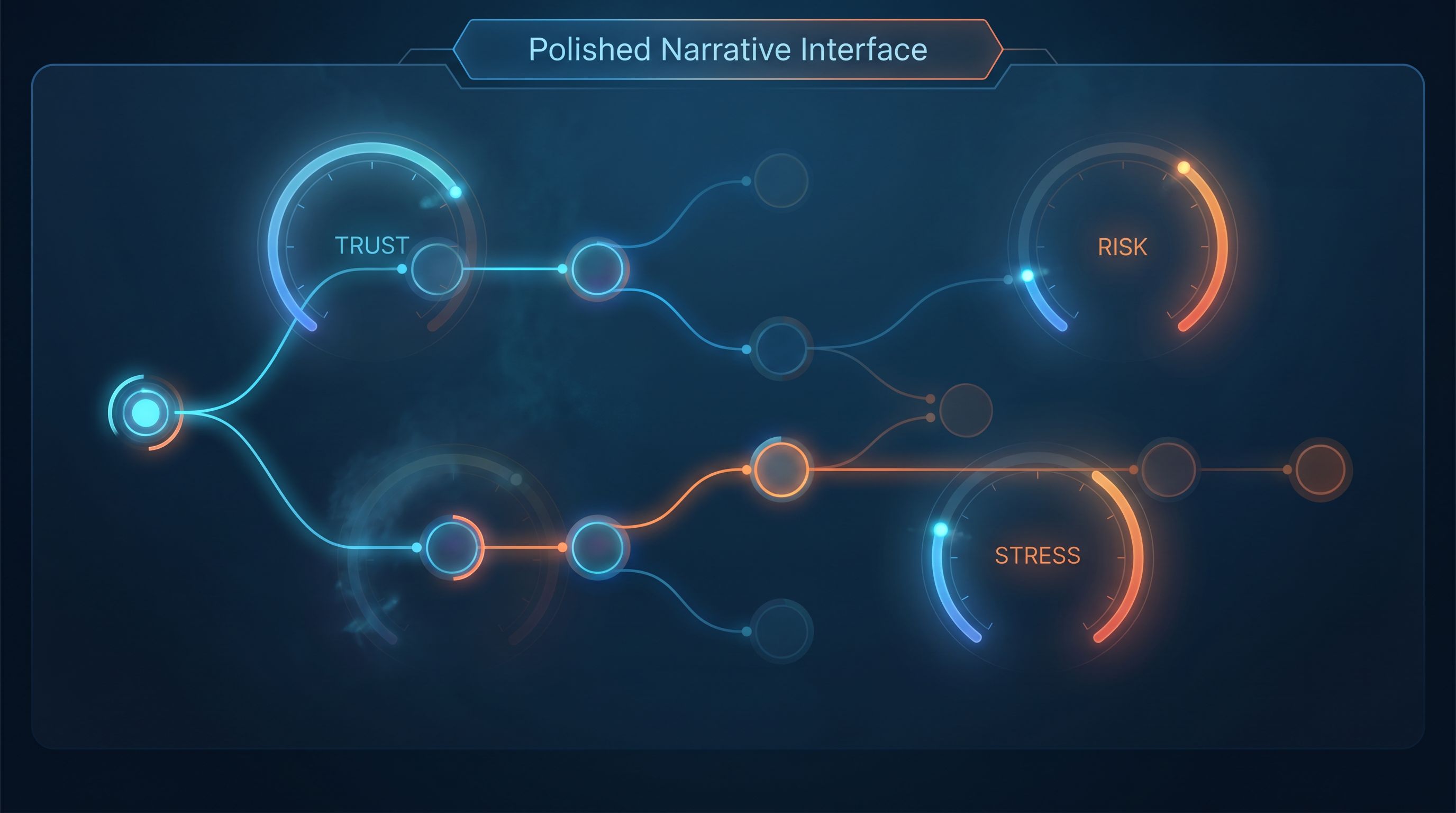
Practical Design Patterns You Can Steal
Here are plug‑and‑play patterns you can drop into your next Questas project.
1. Three-Track Reputation Triangle
Use this when multiple stakeholders matter:
- Variables:
rep_a,rep_b,rep_c. - Every major decision:
- Boosts one.
- Slightly lowers another.
- Finale checks which is highest and routes to a stakeholder‑specific climax.
Works great for:
- Cross‑functional product decisions.
- Political intrigue.
- Multi‑party negotiations.
2. Shadow Score for “Hidden Alignment”
Sometimes you want to track a theme like “short‑term vs. long‑term thinking” without telling players.
- Variable:
short_term_bias(starts at 0). - Quick wins add +1; patient choices add -1.
- Final debrief reads the value and frames your “style.”
Implementation:
- Tiny adjustments on lots of choices.
- No gates during the story—only payoff in reflection.
3. Strike System for Failure
Instead of instant game over:
- Variable:
strikes(starts at 0). - Risky or incorrect actions add +1.
- At
strikes == 3, you trigger a “learning failure” scene with rich feedback, then optionally let them restart with some variables preserved.
Great for:
- Compliance and safety.
- Onboarding simulations.
- Skill drills where you want tension but not punishment.
4. Relationship Web
Instead of one global “charisma” score, track a few key relationships:
rel_alex,rel_jordan,rel_sam.- Choices often affect more than one person at once.
- Later, who shows up to help depends on these scores.
Implementation details:
- Use labels like
+Alex/-Jordanon nodes. - At key beats, check multiple relationships at once: e.g., if
rel_alex >= 2 AND rel_jordan >= 2, unlock a special team‑up scene.
Keeping Complexity Manageable (Without a Dev Team)
Systems are powerful—but they can also get messy. A few guardrails:
Start with One or Two Meters
Resist the urge to track everything.
- Begin with a single reputation or one emotional meter.
- Ship a playable slice.
- Only then layer in more.
If you’re doing a short build, the approach in The One-Evening Story Sprint pairs well with a lightweight system: one meter, one payoff, done.
Use Checkpoints and Summaries
Every few scenes, ask yourself:
- “What has changed in the world because of the meters?”
- “Where can I pay off or hint at these changes?”
Drop in small reflective beats:
- NPCs commenting on your reputation.
- Environmental changes (guards more alert, allies more relaxed).
- Internal monologue tied to emotional meters.
Build Debug Views for Yourself
Even without code, you can:
- Add temporary UI text that displays variable values during testing (e.g., “Debug: Rebels = 2, Council = -1”).
- Color‑code nodes heavily involved in system logic.
- Keep a simple doc listing each variable and where it’s changed.
Once you’re confident, hide or remove the debug text for players.
Reuse Systems Across Stories
The real power move is to treat systems as reusable patterns:
- Copy a story that has a well‑tuned reputation system.
- Swap in new characters, settings, and visuals.
- Keep the underlying meters and gates.
Over time, you’ll build your own internal “library” of:
- Trust systems.
- Risk systems.
- Multi‑faction webs.
- Emotional state trackers.
All of them authored visually in Questas, no engineering backlog required.
Bringing It All Together
When you combine:
- Reputation (who remembers what you did),
- Factions (groups with values and power), and
- Hidden meters (internal states, risk, mastery),
…you move from “interactive story” to living system.
Learners, players, and teams stop asking, “What’s the right answer?” and start asking, “What kind of person am I being in this story?”
That’s the shift that makes branching narratives unforgettable—whether you’re:
- Training safety protocols.
- Rehearsing hard conversations.
- Launching an interactive product demo.
- Or telling a sprawling sci‑fi epic.
And with Questas, you can do all of it with a visual editor, AI‑generated images and videos, and no dev team.
Your Next Step
You don’t need to redesign your entire story to start using systems.
Pick one of these moves and ship it this week:
- Add a single trust meter with one NPC and pay it off in the finale.
- Introduce two factions and let players meaningfully side with one.
- Track a hidden emotional state like stress and use it to gate one crucial choice.
Open Questas, sketch a small node graph, and experiment. Once you’ve felt how different it is when the story quietly remembers what players do, you’ll never want to go back to flat branches.
Adventure awaits—and now, so do your systems.