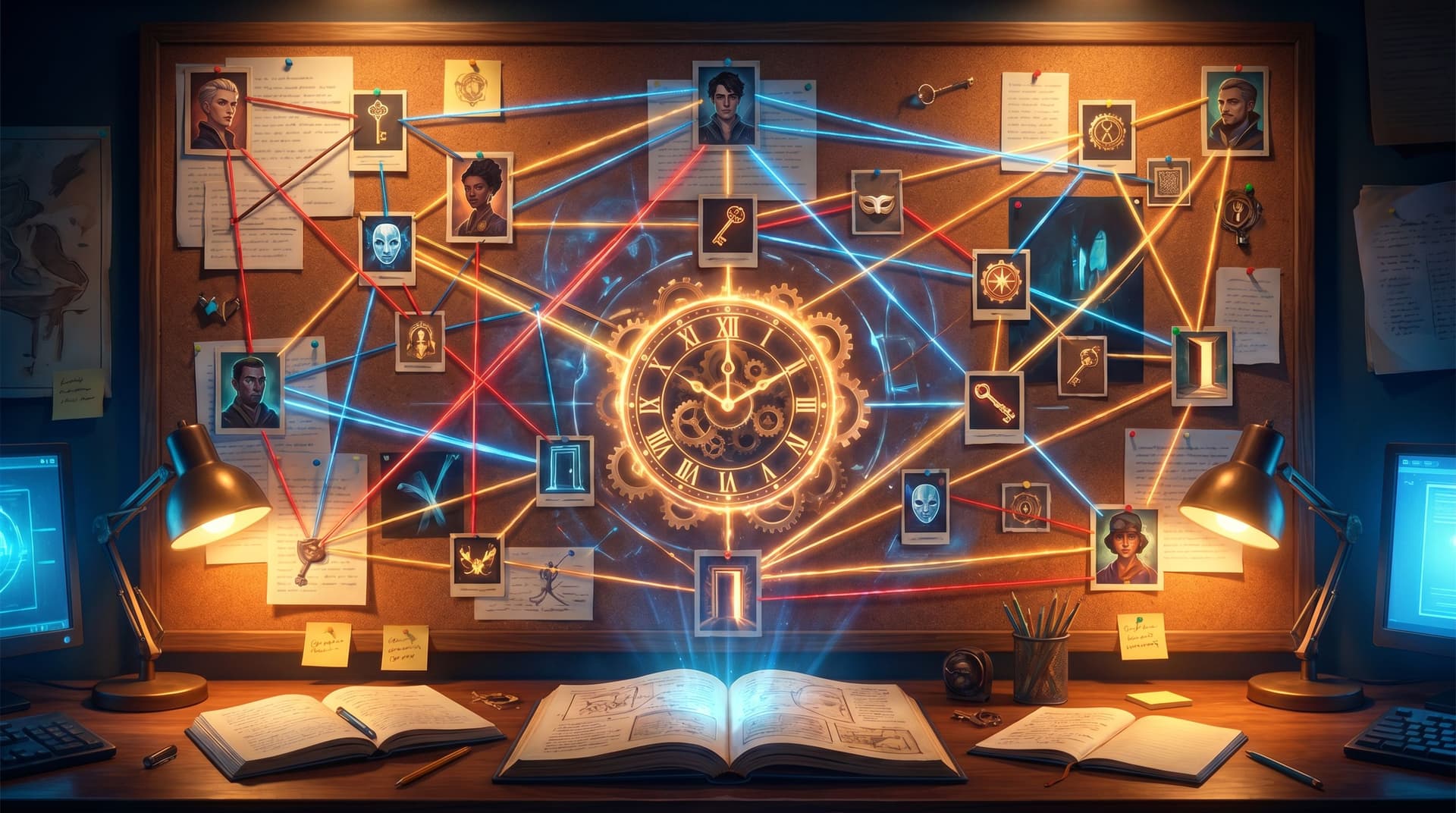
Playable Portfolios: How Creators Use Questas to Showcase Skills, Case Studies, and Side Projects

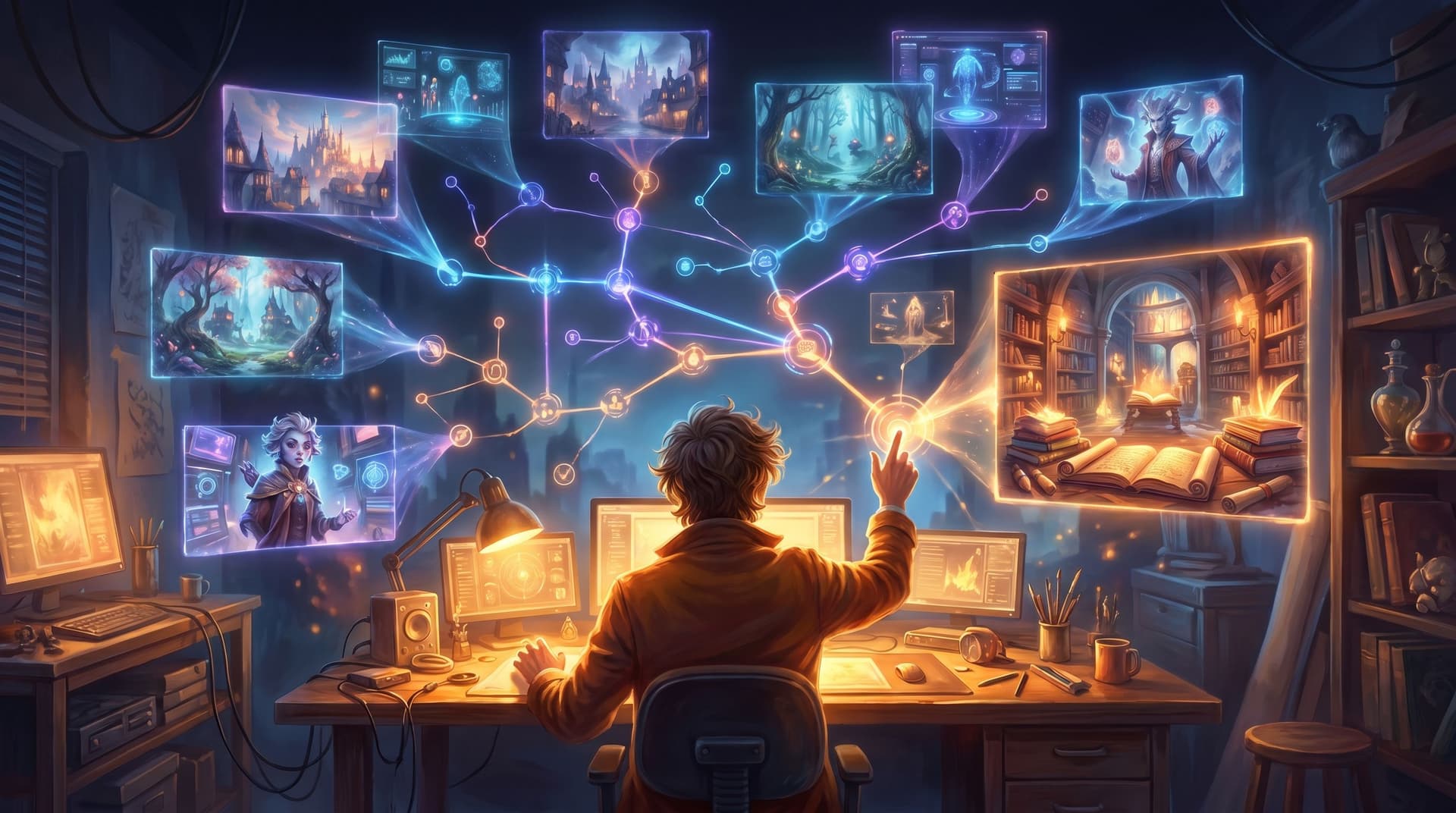
Most portfolios are brochures: static pages, polished screenshots, and a wall of text about “impact.” Helpful, sure—but they rarely show how you think, decide, and create.
Playable portfolios flip that script.
Instead of asking people to scroll, you invite them to play through your skills. Recruiters, clients, collaborators, or fans step into branching scenarios, make choices, and experience your work the way a player would experience a game.
On a platform like Questas, that’s not a fantasy UI mock. It’s a real, no‑code build: an interactive, choose‑your‑own‑adventure story with AI‑generated visuals and video that doubles as your portfolio, case study, or side‑project gallery.
This post is a deep dive into how creators are turning portfolios into playable experiences—and how you can do the same.
Why a Playable Portfolio Beats a Static PDF
A playable portfolio is any portfolio where the viewer actively makes decisions that shape what they see next. Instead of passively reading, they:
- Choose which project to “enter” as a story.
- Navigate branching scenes that reveal your process.
- See consequences and outcomes unfold visually.
That matters because:
1. It reveals how you think, not just what you shipped.
A traditional case study might say, “We explored three concepts and tested two prototypes.” A playable version lets the visitor pick a concept, see what went wrong, and then back up to try another path.
2. It makes complex work legible.
If you’re a systems thinker—product strategist, experience designer, narrative designer, learning architect—your value often lives in decision trees and trade‑offs. Branching stories are a natural fit.
3. It creates memorable, shareable moments.
People remember when they caused something to happen on screen. A surprising branch, a delightful visual payoff, or a “you failed this stakeholder” ending is infinitely more shareable than another static slide deck.
4. It signals that you’re comfortable with interactivity and AI.
Whether you’re applying to a game studio, a learning team, a product org, or a creative agency, fluency with interactive formats and AI‑assisted visuals is increasingly a plus. A playable portfolio built in Questas quietly proves you can:
- Structure branching narratives.
- Use AI media tools responsibly.
- Ship something people can click through in a browser.
Three Playable Portfolio Archetypes (and When to Use Each)
Most creators end up gravitating toward one (or a blend) of these patterns.
1. The “Choose Your Project” Hub
Think of this as a playable homepage.
Visitors arrive in a simple scene—maybe a studio, a starship hangar, or a workshop bench—where each door, console, or artifact represents a real project. Their first choice is their navigation.
Best for:
- Designers and developers with 3–7 flagship projects.
- Creators who want to communicate range (different industries, mediums, or roles).
How it works in Questas:
- Create a hub scene: a single node with a few clear choices (e.g., “Explore the fintech redesign,” “Enter the training sim,” “Visit the fan project”).
- Each choice branches into a mini‑quest that tells the story of that project.
- Use AI images to give each project its own visual flavor while keeping your personal brand consistent. For tips on visual cohesion, see how we approach it in AI as Art Director: Building Cohesive, On-Brand Visual Languages for Your Questas Series.
2. The “Play the Case Study” Simulation
Instead of reading about what you did, the visitor re‑plays the decisions you faced.
You drop them into a moment from the project:
“You’re leading a discovery workshop and the VP just derails the agenda. Do you…”
Their choices unlock:
- The constraints you were under.
- The research you ran.
- The trade‑offs you made.
- The outcomes you achieved.
Best for:
- UX, product, and research case studies.
- Learning designers and facilitators.
- Consultants and strategists.
How it works in Questas:
- Start from a real “oh no” moment in the project.
- Build 5–10 scenes that branch just enough to show alternate paths (what you could have done vs. what you chose).
- Use soft fails and recoveries so visitors can make mistakes without ending the story too soon. If you want to go deeper on that design pattern, Designing ‘Soft Fails’ in Questas: Letting Players Mess Up Without Breaking the Story is a great companion read.
3. The “Side Project Storyworld” Tour
If you’re a storyteller, GM, or fandom creator, your “portfolio” might really be a universe.
Here, the portfolio is a playable anthology:
- Each route is a different side project or experiment.
- Players meet recurring characters and locations.
- They see how your writing, worldbuilding, or system design has evolved.
Best for:
- Narrative designers and game writers.
- Fan creators and webcomic artists.
- GMs and story‑focused streamers.
You can structure this like a small hub world that lets people hop between episodes or AUs. For inspiration on anthology‑style builds, check out From Linear Fan Zines to Playable ‘What Ifs’: Designing Community-Driven Questas Anthologies.
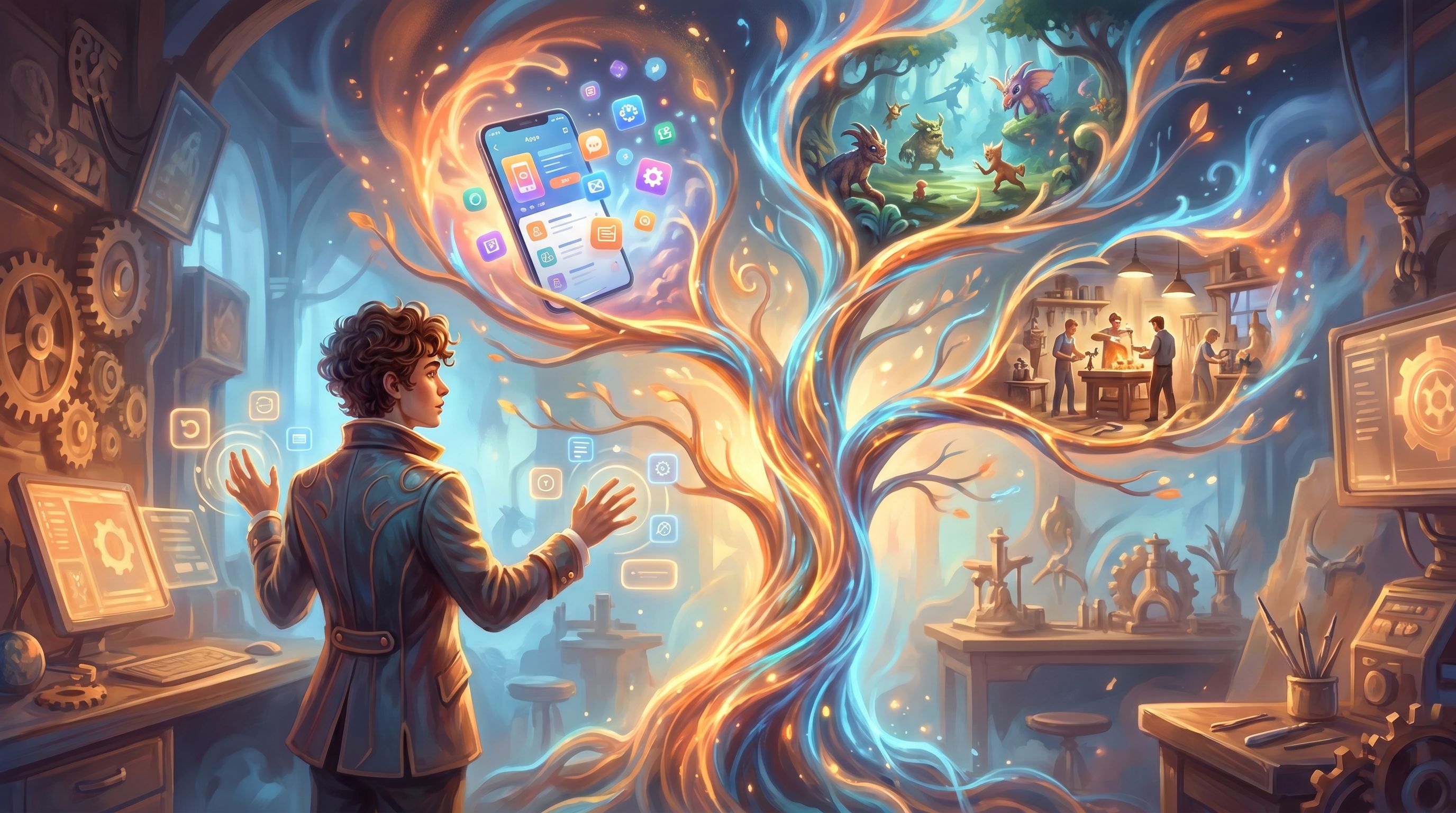
Designing Your First Playable Portfolio in Questas
Let’s walk through a concrete build you can finish in a weekend.
Step 1: Pick One Clear Audience and Goal
Before you open the editor, decide:
- Who is this for? A hiring manager? Prospective clients? Fans? Students?
- What do you want them to do after playing? Book a call? Invite you to interview? Explore more of your work? Subscribe?
Write a one‑sentence design brief:
“A 10‑minute playable case study that shows product leaders how I handle ambiguous discovery projects and nudges them to schedule a chat.”
Keep this visible while you build.
Step 2: Choose One Project (or Story Spine)
Avoid the temptation to cram your entire career into your first quest. Start with one of:
- A flagship client project.
- A side project that best represents your flavor.
- A composite scenario that blends several similar projects.
Ask:
- Where were the real decisions?
- Where did you change course based on new information?
- Where did things nearly go wrong?
Those moments become your choice points.
Step 3: Map a Tiny Branching Structure
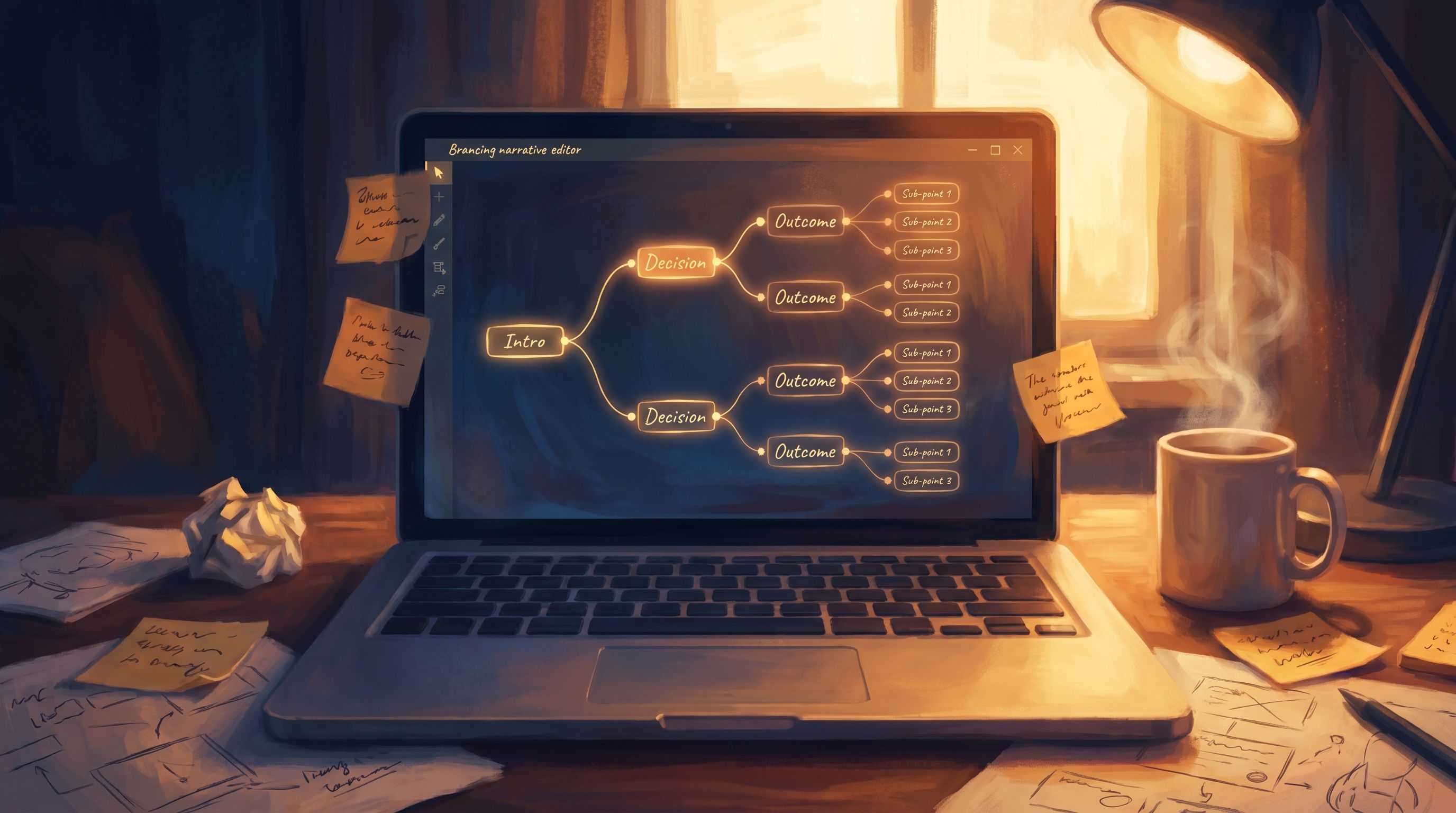
Inside Questas, sketch a minimal structure:
- Intro scene – Set the stakes in 3–5 sentences.
- Decision 1 – A fork that reflects a genuine trade‑off you faced.
- Two short branches – Each 2–3 scenes showing the consequences.
- Convergence – Bring paths back to a shared “what we did” route.
- Outcome scene – Show results, metrics, or narrative payoff.
- Epilogue + CTA – Reflect on what you learned and invite next steps.
This doesn’t need to be a sprawling tree. Even 8–12 scenes can feel rich if each choice is meaningful. If you want a deeper dive into branching patterns that keep things coherent, Beyond the Hero’s Journey: Non-Linear Story Structures That Shine in Questas is a helpful framework.
Step 4: Turn Portfolio Sections into Scenes
Translate familiar portfolio beats into interactive scenes:
- Problem / context → A first‑person scene where the player is “you” arriving at the challenge.
- Research / discovery → A choice between methods or stakeholders to talk to.
- Ideation → Branches where different concepts are explored.
- Testing / iteration → Scenes where feedback forces a pivot.
- Outcome → A visual reveal of the shipped thing, plus a short reflection.
For each scene, ask:
“What decision did I make here that someone else might have made differently?”
That’s where you add a branching choice.
Step 5: Use AI Visuals to Strengthen, Not Distract
Questas lets you generate images and video directly in the visual editor. To keep your portfolio focused:
- Pick a consistent visual style (e.g., clean semi‑realistic UI mockups, soft painterly office scenes, bold comic‑book panels).
- Limit yourself to 1–2 images per key scene to avoid visual overload.
- Use visuals to clarify context, not just decorate: show the workshop room, the whiteboard, the app before/after, the game UI.
If you’re planning a multi‑episode portfolio series (say, one quest per project), it’s worth investing in a reusable style guide and shot list—something we unpack in From Style Guide to Shot List: Building Reusable Visual Systems for Ongoing Questas Series.
Step 6: Build Gentle Failure and Replay Hooks
One of the joys of a playable portfolio is letting visitors mess up safely.
- If they choose a weaker research method, show the consequences (stakeholder confusion, misaligned expectations), then offer a way to recover.
- If they skip user testing, let the story surface the risk and then rewind.
Design “soft fails” that:
- Reveal your judgment (why you didn’t choose that path).
- Make the experience more memorable.
- Encourage a second run to see alternate endings.
Replay value is especially powerful here: the more paths they explore, the more time they spend with your thinking. For structural ideas, Designing Replay Value on Purpose: Structuring Questas Stories So Players Actually Want a Second Run offers patterns you can adapt directly to portfolios.
Step 7: Close with a Human Invitation
Your final scene shouldn’t just say “The End.” It should:
- Reflect briefly: what did the player just experience about you?
- Surface a few key strengths in plain language.
- Offer a clear next step:
- “View my full resume.”
- “Email me about collaborations.”
- “Book a 20‑minute call.”
You can link out to your site, LinkedIn, GitHub, itch.io, or newsletter directly from that epilogue scene.
Practical Tips for Different Types of Creators
Designers and UX Researchers
- Let the player pick a stakeholder perspective (user, PM, engineer) and see how your decisions affected each.
- Use branching paths to highlight how you handle conflicting feedback.
- Include at least one branch where you change your mind based on evidence—that’s gold for hiring managers.
Developers and Technical Creators
- Turn a complex system into a playable explainer: let visitors choose implementation options and see trade‑offs in performance, complexity, or maintainability.
- Use scenes to reveal how you debugged a gnarly issue or refactored a legacy system.
- Link out to repos or live demos from key scenes.
Learning Designers, Facilitators, and Coaches
- Build a short decision drama where the player runs a workshop, coaching session, or training module.
- Show how you handle resistance, disengagement, or conflicting goals.
- Use branching to surface alternative facilitation moves and their outcomes.
Narrative Designers, GMs, and Storytellers
- Treat your portfolio as a micro‑campaign: a self‑contained story that showcases your worldbuilding, pacing, and choice design.
- Include a route where the player can view design notes—meta commentary on why you structured things the way you did.
- Offer a branch that jumps into a live‑play or stream‑ready scene to demonstrate how your content runs at the table.
Measuring Whether Your Playable Portfolio Works
Once your quest is live, treat it like any other product experiment.
Track (even informally):
- Completion rate: Do most visitors reach the final scene?
- Branch exploration: Are people replaying to see alternate outcomes?
- Time on quest: Are they spending more time here than on your static pages?
- Conversion: Do they click your final CTA (email, booking link, repo, etc.)?
You can iterate quickly in Questas: tweak branches, clarify stakes, or shorten overlong sections based on what you see.
A few lightweight improvement loops:
- If people drop off early: Tighten your intro, raise the stakes faster, or reduce exposition.
- If no one replays: Make at least one branch visibly different (a surprising failure, a secret scene, or a radically alternate outcome).
- If they don’t convert: Strengthen your final invitation and make the next step friction‑free (no long forms, just a clear link).
Bringing It All Together
Playable portfolios are more than a gimmick. They’re a natural evolution for creators whose work already lives in choices, systems, and stories.
With Questas, you can:
- Turn your best case study into a 10‑minute simulation.
- Wrap your side projects in a cohesive storyworld.
- Let people experience your process instead of just reading about it.
Along the way, you sharpen the very skills many teams are hungry for: structuring branching narratives, communicating under uncertainty, and using AI visuals with intention.
Where to Start This Week
If you’re feeling the pull to build your own playable portfolio, here’s a simple starting plan:
- Pick one project you’re proud of and write a one‑sentence design brief.
- Sketch 8–12 scenes on paper or a whiteboard—just titles and arrows.
- Sign up for Questas (if you haven’t already) and recreate that sketch in the visual editor.
- Add minimal text and a handful of images, focusing on clarity over polish.
- Share it with one trusted friend or colleague and watch them play. Note where they hesitate, laugh, or get confused.
- Refine once, then link it from your site, LinkedIn, or resume.
You don’t need a sprawling storyworld or studio‑grade art to make an impact. A small, sharp, replayable experience that reveals how you think will stand out far more than another static slide deck.
Adventure awaits in your own work. It’s time to make it playable.