From Forum Threads to Playable Drama: Turning Online Community Debates into Questas Scenarios


Online communities are already telling stories—they just don’t look like stories yet.
They look like:
- A 200‑comment Reddit thread about whether AI art is “real art”
- A Discord blow‑up over a game balance patch
- A fandom forum arguing about which ending of a show is canon
- A professional Slack debating whether to go fully remote
These aren’t just arguments. They’re branching narratives in disguise: different personas, conflicting values, escalating stakes, and a maze of “if they say this, then I’ll say that” moments.
With Questas, you can turn those messy, emotional debates into playable, choose‑your‑own‑adventure scenarios—complete with AI‑generated images and video. Instead of skimming a heated thread, your audience can step into it, make choices, and feel the consequences from the inside.
This post is about how to do that: how to go from raw forum drama to a structured, replayable Questas scenario that teaches, entertains, or reveals something real about your community.
Why Community Debates Make Powerful Playable Stories
Before we get tactical, it’s worth naming why this format works so well.
Online debates are:
- Emotionally charged. Stakes feel real: identity, status, values, money, ethics.
- Naturally branching. Every reply is a micro‑choice; every subthread is a branch.
- Rich in perspectives. You get multiple archetypes (the veteran, the newcomer, the troll, the mod, the lurker).
- Grounded in reality. These aren’t hypothetical thought experiments; they’re lived tensions.
When you transform a debate into a Questas scenario, you get several benefits:
- De‑risked exploration. People can try out controversial stances without flaming anyone.
- Empathy building. Players inhabit different roles and see why each side thinks it’s “obviously right.”
- Reusable training. Communities, moderators, and teams can replay the same scenario to practice responses.
- Content alchemy. A one‑off argument becomes a durable interactive asset: a game, training, or research tool.
If you’ve explored ideas like playable personas or interactive thought experiments, you’ve already seen how powerful this can be. Turning debates into scenarios is a close cousin of what we covered in Designing ‘Playable Personas’: Using Questas to Let Teams Step Into Their Users’ Shoes and Interactive Thought Experiments: Turning ‘What If?’ Questions into Playable Questas Scenarios.
Step 1: Pick the Right Thread (and Narrow the Question)
Not every argument is worth turning into a scenario. You’re looking for debates that are:
1. High‑signal, not just high‑volume
Look for threads where:
- Multiple perspectives are articulated clearly
- People share concrete stories, not just hot takes
- There’s a real decision or trade‑off at the core
Examples:
- “Should our open‑source project accept corporate sponsorship?”
- “Is it ethical to use AI to write college essays?”
- “Should our game ban pay‑to‑win mechanics?”
2. Centered on a clear decision point
Boil the thread down to a single, sharp question:
“If you were the moderator / founder / product owner / community member, what would you do?”
Some strong framing questions:
- Do we ban this user or give them another chance?
- Do we ship this controversial feature or delay it?
- Do we change the community rules or keep them as‑is?
3. Scoped enough to fit into a short quest
You’re not recreating a 500‑comment thread line by line. You’re building a tight, replayable scenario.
A good starter scope:
- 1–2 key roles (e.g., mod vs. long‑time member)
- 3–5 major decision points
- 2–4 distinct endings (e.g., community fracture, compromise, quiet resentment, breakthrough)
If you’re unsure how small you can go, revisit The Minimal Viable Quest: Tiny, Three-Choice Questas Formats That Still Deliver Big Insight. The same principles apply here.
Step 2: Extract the Drama, Not the Drama Llamas
You’re not trying to faithfully reproduce every snarky comment. You’re distilling the underlying tensions.
Go through your source thread and:
Identify the core fault lines
As you skim, jot down recurring themes:
- Values: fairness vs. freedom, growth vs. purity, safety vs. openness
- Fears: “We’ll lose our core users,” “We’ll get canceled,” “We’ll be exploited”
- Assumptions: “New users don’t care about the culture,” “Mods are power‑tripping,” “Founders only care about revenue”
These become the axes your scenario explores.
Turn commenters into playable archetypes
You don’t want to copy individuals. Instead, blend them into archetypes like:
- The Veteran Purist – cares deeply about tradition and norms
- The Newcomer Optimist – sees potential, less attached to history
- The Overworked Moderator – juggling fairness, rules, and burnout
- The Pragmatic Founder – balancing ideals with survival
- The Chaos Agent – testing boundaries, sometimes malicious, sometimes just bored
Each archetype should:
- Have clear goals (what they want)
- Hold strong beliefs (why they think they’re right)
- Face real constraints (time, power, social pressure)
These will inform dialogue options and branching outcomes later.
Map emotional beats
Most heated threads follow a recognizable emotional arc:
- Inciting incident – A post, policy change, or event triggers debate.
- Escalation – Misunderstandings, dogpiling, quote‑tweeting, call‑outs.
- Crisis point – Someone threatens to leave, gets banned, or calls for a boycott.
- Resolution (or non‑resolution) – Rules change, a statement is issued, or everyone just… cools off.
In your Questas build, these beats become chapters or scenes, each with its own choices and consequences.
Step 3: Translate Thread Chaos into a Branching Structure
Now it’s time to move from raw notes to a playable outline.
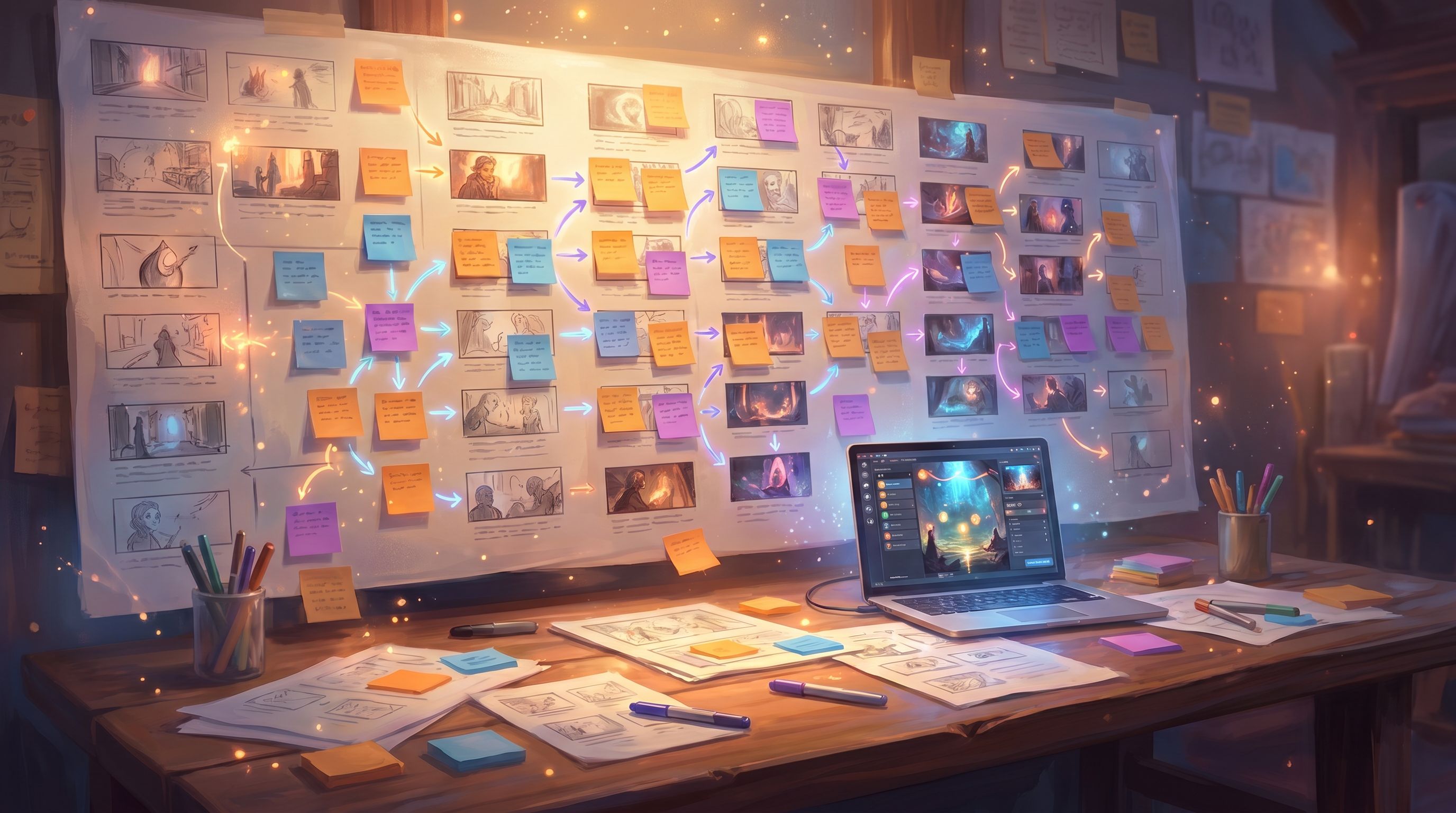
Using the visual, no‑code editor in Questas, you can build this structure as a node graph. Start simple:
Choose your player role
Ask: Who does the player get to be? Options:
- The moderator deciding how to handle the conflict
- The founder weighing policy changes
- A regular member deciding whether to speak up, stay silent, or leave
- A “switching perspective” structure where each chapter jumps to a different role
Single‑POV is usually easier for your first build.
Define your key decision points
Aim for 3–5 pivotal choices, such as:
- Initial response – Do you ignore, gently redirect, or intervene hard?
- Enforcement – Do you apply rules strictly, flex them, or revise them on the fly?
- Communication – Do you issue a public statement, DM individuals, or quietly adjust settings?
- Aftermath – Do you debrief, survey members, or pretend nothing happened?
For each decision point, sketch:
- Options (2–4 meaningful choices)
- Immediate consequences (what changes right away)
- Downstream effects (what this unlocks or forecloses later)
Use branches to surface hidden trade‑offs
The power of branching is showing that every stance has a cost.
For example, if the scenario is about banning a controversial member:
- Ban quickly → short‑term relief, long‑term fear of arbitrary power.
- Delay and investigate → accusations of inaction, but more context.
- Mediation attempt → time‑consuming, may fail, but can model restorative practices.
As you build in Questas:
- Use labels or tags on branches to track values (e.g.,
safety++,trust--,growth+). - Consider reusing scenes via conditional logic (e.g., the same “community meeting” scene plays differently depending on prior choices).
For more on keeping larger branching structures coherent, the techniques in AI as Continuity Editor: Keeping Plot, Canon, and Visuals Aligned Across a Questas Series can help you avoid contradictions.
Step 4: Use AI Visuals to Make Abstract Arguments Feel Concrete
Community debates are often about invisible things—policies, norms, feelings. Visuals make them felt.
With AI‑generated images and micro‑video inside Questas, you can:
Visualize the “room” where it happens
Even if the argument lives online, you can:
- Show a mod dashboard filling with reports
- Depict a Discord server view with channels lighting up
- Render a community town hall in a stylized, metaphorical space (e.g., a floating forum in space, a courtroom made of emojis)
Represent emotional states
Use visuals to:
- Shift color palettes as tension rises (cool → warm → harsh reds)
- Change camera framing (wide shots for calm, tight close‑ups for confrontation)
- Introduce symbolic elements (fracturing glass, overlapping speech bubbles, muted avatars)
The techniques in Camera Moves Without a Camera: Simulating Pans, Zooms, and Cuts with AI Images in Questas and Storyboard to Screen: Using AI-Generated Micro-Video to Pace Tension and Reveal in Your Questas are especially useful here.
Match visuals to branches
You don’t need a unique image for every node, but you do want:
- Distinct looks for different outcomes (e.g., thriving community vs. ghost town)
- Visual callbacks that reinforce player impact (e.g., the same community space, but with more or fewer active members depending on choices)
Start with:
- 1 image for each major chapter
- 1–2 micro‑videos for pivotal moments (e.g., when you announce a decision)
Step 5: Write Dialogue That Sounds Like the Thread (Without Copying It)
Your goal is to capture the voice of the community, not quote individuals.
Capture authentic tone
As you draft dialogue:
- Sprinkle in in‑group language (jargon, memes) sparingly
- Reflect different rhetorical styles:
- The data‑driven poster with links and charts
- The anecdote‑driven member (“In my experience…”)
- The sarcastic commenter who undercuts everything
- Let characters interrupt or misinterpret each other in subtle ways—this is how real arguments escalate
Give players meaningful speech options
At each choice, offer:
- A direct option (clear, firm stance)
- A diplomatic option (bridging, reframing)
- A deflecting or avoidant option (changing subject, stalling)
Avoid purely cosmetic choices. Each option should:
- Reveal something about the player’s values
- Shift at least one relationship or community metric
- Unlock or close off lines of dialogue later
Use AI as a drafting partner, not the final say
You can:
- Paste anonymized snippets of the original thread into an LLM prompt (outside of your quest) to generate variant phrasings.
- Ask for alternative tones (more formal, more casual, more empathetic) for the same line.
Then, bring the best lines back into your Questas scenes and tweak them until they feel right.
Step 6: Design Endings That Teach, Not Just Punish
The endings of your scenario are where the “lesson” crystallizes—explicitly or implicitly.
Aim for 2–4 distinct outcomes, such as:
- Fractured Community – You “win” the argument but lose trust; key members leave.
- Silent Resentment – No blow‑up, but engagement drops as people quietly disengage.
- Messy Compromise – No one is fully happy, but norms are clearer and participation stabilizes.
- Transformative Change – The conflict leads to better structures (clearer rules, shared ownership, new roles).
For each ending, show:
- Concrete metrics (e.g., active members, flagged posts, new joiners)
- Short epilogues from multiple perspectives (“Six months later, the veteran purist thinks…”)
- Reflection prompts for the player (“If you replayed, what would you try differently?”)
This is where your scenario becomes not just drama, but a learning tool—for moderators, community managers, founders, or even the community itself.
If you plan to use your scenario for training or research, the measurement ideas in From Playtest Notes to Narrative Analytics: What to Measure (and Ignore) in Your Early Questas Builds can help you track which paths players actually take.
Step 7: Playtest With the Community (Without Re‑Igniting the Fight)
You’ve built your first draft in Questas. Now you need to see how it lands—carefully.
Choose your testers thoughtfully
Start with:
- A small, mixed group: a few veterans, a few newcomers, maybe a moderator or two.
- People who weren’t the main combatants in the original thread.
Explain the intent clearly:
“We turned one of our past debates into a playable scenario to help us practice tough conversations and explore different outcomes—this isn’t about calling anyone out.”
Ask the right feedback questions
After they play, ask:
- Which choices felt most realistic? Which felt missing?
- Did any character feel like a caricature or unfair portrayal?
- Did any outcome feel “rigged” or preachy?
- What did you notice about your own instincts as you played?
Use this to:
- Adjust dialogue that feels off
- Add or remove branches
- Rebalance outcomes that feel too binary or moralizing
If you’re collaborating with other writers, facilitators, or subject‑matter experts, the techniques in The Collaborative Quest Room: How Distributed Teams Co‑Write, Co‑Prompt, and Co‑Playtest Questas in Real Time can help you iterate together instead of in silos.
Step 8: Put Your Scenario to Work
Once your scenario feels solid, think about how it can serve your community or team.
Some practical use cases:
- Moderator training – New mods play through “greatest hits” conflicts from your community before they get full powers.
- Onboarding – New members explore a short quest about “how conflict works here” instead of just reading rules.
- Policy experiments – Leadership teams play different branches to see how proposed rule changes might feel.
- Research – Instead of surveys, you let members choose paths in a scenario and analyze which values they prioritize—similar to the approach in Branching Narratives for Brand Research: Let Customers ‘Choose Their Own Pain Points’ Before You Build.
Because Questas runs in the browser and doesn’t require code, you can:
- Share links in Slack, Discord, or your forum
- Run scenarios live in workshops or office hours
- Collect playthrough data to refine both the scenario and your real‑world policies
Bringing It All Together
Turning online community debates into playable scenarios is about more than gamifying drama. It’s a way to:
- Surface the real trade‑offs behind hot takes
- Build empathy across factions
- Practice better decisions in low‑risk environments
- Transform disposable arguments into reusable story assets
The workflow looks like this:
- Choose a high‑signal thread with a clear decision at its core.
- Extract values, fears, and archetypes instead of copying comments.
- Map a branching structure around 3–5 key decisions.
- Use AI visuals in Questas to make the invisible visible.
- Write authentic dialogue that offers meaningful choices.
- Design endings that reveal consequences without preaching.
- Playtest and refine with a small, representative group.
- Deploy the scenario for training, onboarding, research, or community reflection.
Do this a few times, and your community’s “worst threads” become some of your most valuable stories.
Your Next Move
You probably already have a thread in mind—a debate that still echoes in your community, or a recurring argument you’re tired of re‑litigating.
Here’s a simple way to start this week:
- Pick one thread and write a one‑sentence question that captures its core decision.
- List 3–5 archetypes who showed up in that debate.
- Open Questas and sketch a tiny, three‑choice version of the scenario—just an opening scene, one big decision, and two different outcomes.
You don’t need a perfect epic. You just need a first, playable draft.
Adventure awaits in the arguments you’ve already had. Now you can let people play them—on purpose.