From Fanfic to Playable Canon: Turning Online Fandoms into Branching Questas Storyworlds

Fandom has always been about participation.
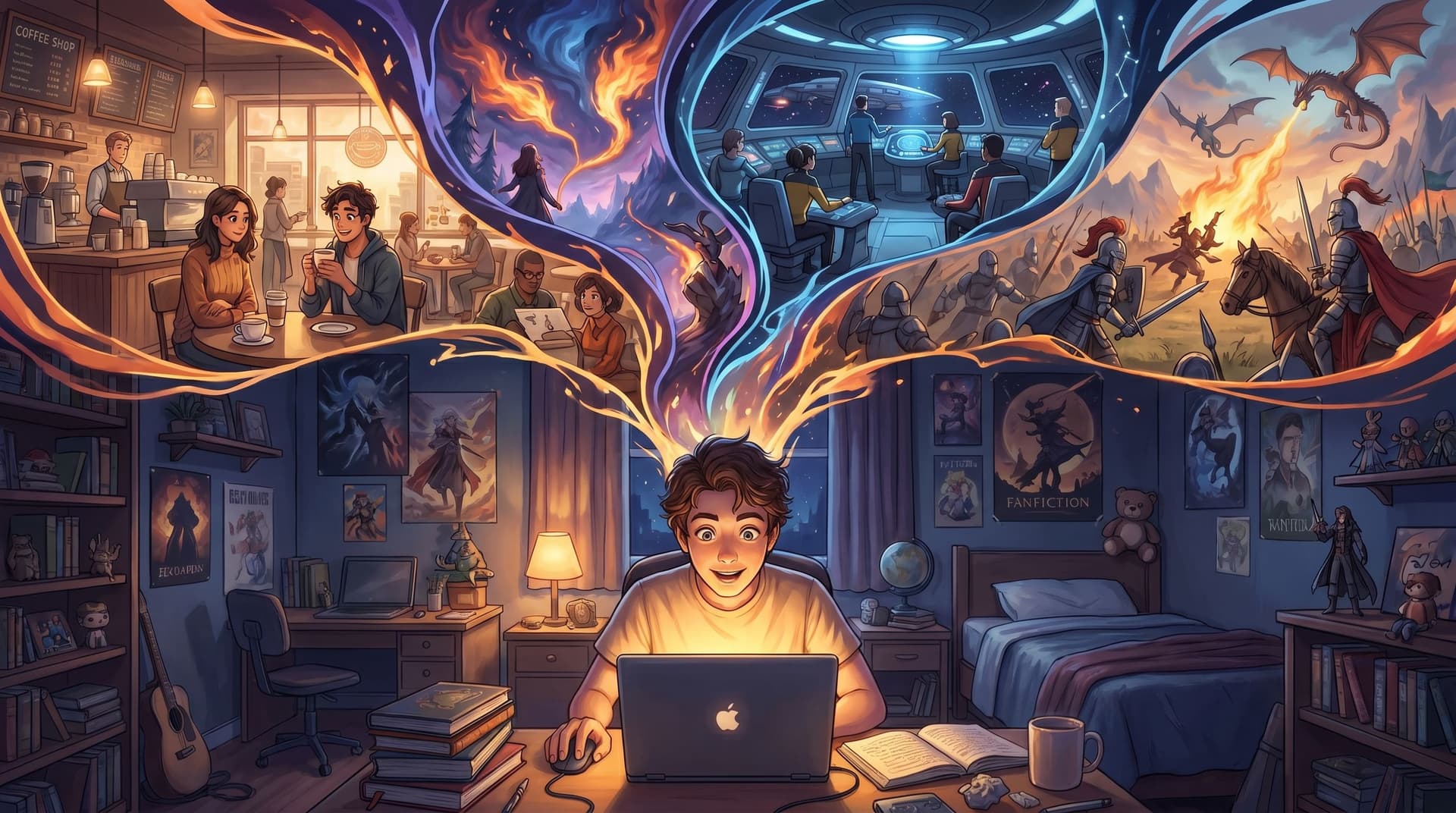
First it was zines and mailing lists. Then came forums, roleplay blogs, and sprawling fanfic archives. Now, millions of people are already co-writing alternate universes, fix‑it endings, and ship wars across platforms like Archive of Our Own, Wattpad, Tumblr, and Discord.
What’s changing is how those stories can live.
Instead of staying as static text on a page, your fanfiction universe can become something people play—a branching, visual storyworld where readers make choices, unlock routes, and explore the “what ifs” your fandom is obsessed with.
That’s where a platform like Questas comes in: it gives you a visual, no‑code way to turn fanfic canon, headcanons, and fandom debates into interactive, choose‑your‑own‑adventure experiences powered by AI‑generated images and video.
This post is about how to go from:
“I wrote a 120k canon-divergent fic.”
to
“I run a playable storyworld where fans explore multiple canons.”
We’ll look at why this matters, what makes fandoms uniquely suited to branching narratives, and a practical blueprint for turning your online fandom into a Questas-powered storyworld.
Why Turning Fanfic into Playable Canon Matters
Transforming fan works into interactive stories isn’t just a neat format shift. It changes the relationship between creator, canon, and community.
1. Fandoms are already branching universes
Every major fandom today has:
- Competing theories about character motivations
- Alternate endings people swear are “the real one”
- AU universes (coffee shop, space opera, high school, no‑powers, etc.)
- Long-running roleplays or Discord plots that feel like live story games
You’re already living in a multiverse. Branching stories simply make that structure explicit and playable.
2. Readers want to act, not just observe
Readers don’t just consume fanfic; they:
- Scream in the comments about choices characters should have made
- Write fix‑it fics for scenes that hurt too much
- Reblog meta about “the one decision that broke the timeline”
A branching storyworld lets them:
- Choose whether the character apologizes, runs, confesses, betrays
- See how those choices ripple across timelines
- Replay routes to discover new scenes, ships, or endings
Instead of arguing about hypotheticals, they can play them.
3. Interactive canon builds stickier communities
When your fic becomes a playable storyworld:
- Fans return to unlock new branches instead of reading once and leaving
- You can host watch‑parties or streams where chat votes on choices
(for more on that, see how creators are designing branching narratives for live streams) - Co‑writers, artists, and meta writers can all contribute branches, scenes, or visual prompts
You’re not just publishing stories—you’re running a shared playground.
4. You don’t need to be a dev or game designer
Traditional fangames or visual novels require:
- Coding skills
- Custom art pipelines
- Engine knowledge (Ren’Py, Unity, etc.)
With Questas, you:
- Map branches in a visual, node‑based editor
- Write scenes like you’d write fic
- Generate images and micro‑video with AI prompts
- Publish and share a link—no install, no builds
That means fic writers, RP mods, and fan artists can all ship interactive storyworlds without changing careers.

Step 1: Choose Your “Playable Canon” Concept
You don’t need to convert your entire body of work at once. Start with a concept that naturally branches. A few patterns work especially well:
Fix‑it timelines
Pick a single painful canon moment and ask: what if this went differently?
Examples:
- A character doesn’t die in the battle
- The confession isn’t interrupted
- The villain takes the redemption arc
In Questas, that moment becomes a major choice node with:
- Branch A: follow canon
- Branch B: diverge and explore consequences
Ship routes
If your fandom is ship‑heavy, frame your world as:
- A shared prologue (same setup, same inciting incident)
- Multiple mid‑story branches where the protagonist’s choices lean into different relationships
- Distinct emotional arcs and endings per ship
You’re essentially building a multi‑route otome/BNL‑style structure, but with your fandom’s characters and dynamics.
AU hub worlds
Have lots of AUs? Turn them into:
- A central “nexus” scene (e.g., a library of universes, a dreaming character, a godlike narrator)
- Choice points that drop players into:
- Coffee shop AU
- Space opera AU
- College AU
- Role‑swap AU
Each AU can be a short, self‑contained quest that shares visual style and themes.
Tip: If you’re overwhelmed, build a “Minimal Viable Quest” first—a tiny, three‑choice experience that still lands an emotional punch. We’ve broken that format down in The Minimal Viable Quest.
Step 2: Mine Your Existing Fanworks for Branches
You probably have more material than you think. Before you write anything new, inventory your fandom artifacts:
- Longfics and series
- One‑shots exploring alternate outcomes
- Roleplay logs or Discord storylines
- Meta posts about “what should have happened”
- Fanart that hints at scenes you never wrote
Then, look for:
-
Decision points
Any moment where a character could plausibly do A or B:- Tell the truth vs. lie
- Stay with the team vs. go solo
- Save X vs. save Y
-
Emotional peaks
Scenes where readers left long comments, wrote reaction posts, or made fanart:- Confessions
- Betrayals
- Reveals
- Sacrifices
-
Unwritten gaps
Time skips, alluded‑to events, off‑screen conversations—these are perfect places for optional side scenes or secret branches.
Drop these into a rough structure:
- Start node (opening scenario)
- Key decision nodes (from your existing fic)
- Possible endings (canon, fix‑it, tragedy, crack, etc.)
You’ve just turned your archive into a design document.
Step 3: Sketch Your Storyworld Map in Questas
Now it’s time to turn notes into a playable structure.
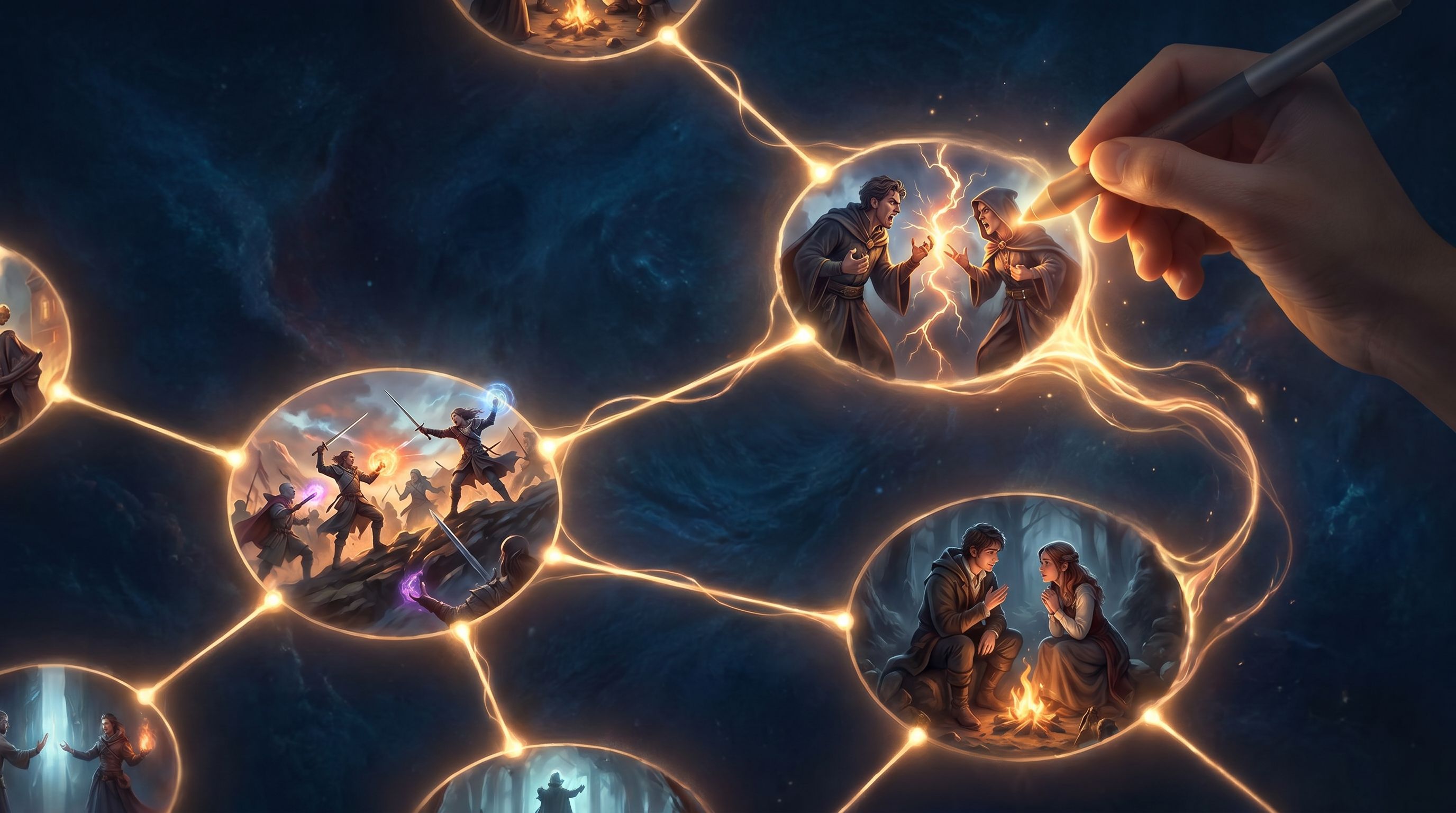
In Questas, you’ll work in a visual, node‑based editor where each node is a scene and each connection is a choice.
A simple mapping workflow
-
Create your starting scene
- Set the setting, POV, and immediate goal.
- Keep it short; you want players making choices quickly.
-
Add your first major choice
- Pull from a decision point you identified earlier.
- Write 2–3 options that feel distinctly different.
-
Branch into 2–3 follow‑up scenes per option
- Think in emotional beats, not word count.
- Each path should deliver a clear change in stakes or relationship.
-
Repeat for 2–3 key decisions
- Don’t overbuild. A compact quest with 10–20 scenes can still feel rich.
If you’re new to structuring choices, you’ll find it helpful to study how different choice types feel. Our post on designing choice types—risky, reflective, and routine digs into this in detail and pairs nicely with fandom scenarios.
Keep your emotional arcs coherent
Even in a branching story, each path should still feel like a real journey, not a random walk. As you place scenes:
- Track tension: where does it rise, break, and resolve?
- Track relationships: how does trust, attraction, or rivalry change?
- Track themes: what questions about canon are you exploring?
If you want a deeper dive into this craft side, see Designing Emotional Arcs in Branching Stories.
Step 4: Use AI Visuals to Make Your Fandom Feel Like a World
One of the biggest upgrades from plain text to playable storyworld is visual presence. You’re not just describing scenes—you’re showing them.
With Questas, you can:
- Generate character portraits with consistent styling
- Render key locations (the base, the café, the throne room)
- Create micro‑video moments to punctuate big choices
Lock in a visual style early
To avoid whiplash (“why does the same character look different in every scene?”), define your style up front:
- 2–3 reference prompts that specify:
- Art style (anime, painterly, semi‑realistic, cel‑shaded)
- Color palette
- Mood (soft and intimate, high‑contrast and dramatic, etc.)
Use those as a style board before you generate dozens of assets. If you want a process for this, we walk through it in From Moodboard to Mission: Using AI Style Boards to Lock In the Look of Your Next Questas World.
Think like a director, not just a writer
You can simulate camera moves without touching a real camera:
- Close‑ups for emotional beats
- Wide shots to establish new branches or locations
- Quick micro‑videos (a door closing, a character turning away) before a choice
These techniques, which we explore in posts like Camera Moves Without a Camera and Storyboard to Screen, are powerful in fandom contexts where tiny gestures and glances carry a lot of meaning.
Step 5: Let Your Fandom Co‑Author the Branches
One of the joys of fandom is that you’re not alone. Once you have a playable core, invite your community to shape what comes next.
Ways to co‑build:
-
Polls for branch priorities
Ask: “Which route should get expanded next?” or “Which what‑if should get its own quest?” -
Guest routes from other writers
- Share a branch template or brief.
- Let them write a self‑contained route in your world.
-
Art‑driven branches
- Commission or request fanart that suggests a scene.
- Build a side quest that pays off that image.
-
Live play sessions
- Stream your quest and let chat vote on choices.
- Note where people hesitate, argue, or scream—those are great spots for additional branches.
Questas is especially well‑suited to this because a storyworld can be:
- Modular: different creators own different routes
- Episodic: you can add new quests over time
- Replayable: fans can come back whenever a new path drops
If you’re coordinating across time zones or teams, the collaboration patterns in The Collaborative Quest Room translate nicely to fandom collectives.
Step 6: Playtest Like a Fandom, Iterate Like a Creator
Interactive stories don’t really live in your editor—they live on your players’ screens.
Before you call your storyworld “done,” run small, focused playtests:
-
Start with a tiny group
- A couple of trusted beta readers
- Maybe your fic beta and one mod from your Discord
-
Ask them to screen‑record or screenshot moments where they:
- Felt confused about a choice
- Got unexpectedly emotional
- Thought “wait, that’s out of character”
-
Look for patterns
- Are some routes rarely chosen? Maybe the choice text is unclear.
- Are players missing key emotional beats? Maybe you need a visual or micro‑video to highlight them.
-
Iterate quickly
- Tweak choice wording
- Re‑order scenes
- Add or remove branches that don’t pull their weight
We’ve written a deeper dive on this process in The Visual Feedback Loop: Using Player Screenshots and Replays to Iteratively Refine Your Questas Worlds. The same principles that help teams refine training sims work beautifully for fandom storyworlds.
Step 7: Share, Sustain, and Scale Your Storyworld
Once your first quest is live, treat it as season one, not a one‑off experiment.
Ways to keep it alive:
-
Seasonal events
- Holiday specials set in your AU
- Anniversary quests revisiting key decisions with new context
-
Thematic spin‑offs
- Side stories from another character’s POV
- Prequels and future timelines
-
Crossovers
- If your fandom is friendly to crossovers, build a quest that bridges two universes.
-
Meta inside the world
- Let a character become aware of the branches
- Build a quest about fix‑it culture itself
Because Questas stores your world as a network of scenes and assets, you can:
- Reuse locations and character art across quests
- Maintain continuity of canon (or deliberately break it)
- Gradually grow from one quest to a whole playable canon that sits alongside traditional fic
For long‑running projects, you’ll eventually care about continuity: keeping plot, canon, and visuals aligned across episodes. When you get there, the techniques in AI as Continuity Editor: Keeping Plot, Canon, and Visuals Aligned Across a Questas Series become very handy.
Bringing It All Together
Turning fanfic into a branching Questas storyworld isn’t about abandoning what you already love. It’s about amplifying it:
- Your canon‑divergent ideas become playable timelines.
- Your ship wars become alternate routes.
- Your AUs become a hub of micro‑adventures.
- Your community becomes a co‑authoring crew.
The shift is less “learn game dev” and more “rethink how you present choices you’re already obsessed with.”
If you:
- Care deeply about characters and their decisions
- Already write or read fanfic
- Want your fandom space to feel more like a shared game than a static archive
…then building a branching storyworld is a natural next step.
Ready to Turn Your Fandom into Playable Canon?
Here’s a simple way to start this week:
- Pick one canon moment you’re obsessed with changing.
- Write down two alternate outcomes.
- Open Questas and:
- Create a start scene leading up to that moment.
- Add a choice with those two outcomes.
- Sketch 2–3 short scenes for each branch.
- Generate 3–5 images to anchor the key beats.
You don’t need a 100k epic or a full VN‑length script. You just need one powerful decision and the courage to let players take it.
Your fandom has been co‑writing worlds in comments and tags for years. It’s time to give them something new to explore:
A story they don’t just read—one they help make canon, every time they play.